






Mikaël Morizot, keeper of Essonne's oldest cress
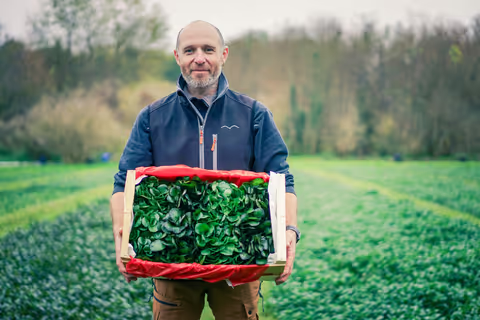
Mikaël Morizot is the fourth generation to run the very first cress farm in Essonne. A historic site for the cultivation of this plant, which could soon obtain its Protected Geographical Indication.

As a child, Mikaël Morizot already had his feet in watercress. " My grandparents grew them at the end of the garden. When I was having fun, I'd sometimes fall into the pond," he recalls with a laugh. In 2008, his playground finally became his workplace. He took over the Sainte-Anne watercress farm. This fifty-acre farm, handed down from generation to generation, is the oldest in Essonne.
Nearly 200 years of history
It all began in 1854, in Vayres-sur-Essonne. Where the Beauce water table gushes out its spring water, essential for providing all the minerals needed for plant growth. Hence the name "cresson de fontaine", a reference to the water troughs at the foot of which the leaves were once gathered. Joseph-Marie Étienne Cardon, a steward of Napoleon's Grande Armée in the 19th century, introduced the plant to France. First in the Oise region, then in Essonne, where Méréville became the cress capital. Here, in the south of the Paris region, 40% of national production is produced. This lettuce, whose medicinal virtues were already known in Antiquity, grows in soil composed of peat and sand, always moistened by a trickle of running water at 10/12°C.
The meticulous production of watercress
two varieties are grown at the Saint-Anne cress farm: the traditional green variety, and the less familiar purple variety, developed quite by accident. " The whole cress business is based on plant selection. One day, in 2014, I got purple pigmentation on the green variety. So I took the precaution of isolating it," says the grower. The purple cress has a sweeter flavor and a spiciness at the end of the mouth, a taste experience to be discovered at the table of the restaurant Le Doyenné, in Saint-Vrain, where Australian chefs Shaun Kelly and James Henry include it on their menu.
But, fortunately, this is not the only way to taste Mikaël Morizot's production. Since 2021, he has been working with Conserverie de la Forêt, in Samois-sur-Seine, to transform the family plant into a sunflower seed-based pesto, but also into hummus, thanks to a combination with preserved lemon and coral lentils. The whole point is to stretch the eating season. " Watercress isn't just for soup, " he says. "People ask us for it when there's less of it! People think it's a winter vegetable, whereas the biggest production peaks are in October/November and March. "

maxime Henry- Ferme & Co
By diversifying the use of watercress, the aim is also to secure know-how. Today, only around twenty producers grow it in Essonne. " It's a key ingredient in French gastronomy. But it's a niche crop," warns Mikaël Morizot, who is working alongside eleven other cress growers,to obtain a Protected Geographical Indication to recognize Méréville cress. However, this initiative will take at least three years to succeed.
Cressonnière Sainte-Anne
- Rue de l'Église, 91820 Vaures-sur-Essonne
- Tel: 06 74 99 12 70
- www.cressonniere-sainte-anne.fr