






French know-how at the service of hotels and palaces
From the art of master glassmakers to 18thᵉ century stonemasons, from court cooks to avant-garde decorators, the hotels perpetuate an invisible heritage.

You only have to walk through the door of a French palace to realize that, beyond the dazzling staging, a discreet theater of savoir-faire is at play. The spectacular is sometimes obvious, but it is always coupled with a quieter refinement: a carefully reupholstered armchair, a moulding that looks new despite the centuries, a bouquet whose rigorous lines border on architectural art. It is these signs, often imperceptible to the hurried eye, that forge the true reputation of these places.
As early as the XVIIIᵉ century, as the nobility traveled between their residences, carpenters and upholsterers were requisitioned to furnish private mansions transformed into prestigious inns. Comfort remained basic, but the art of service "à la française", codified in aristocratic homes, was already unfolding: the art of the table, the hierarchy of dishes, the precision of gestures. In the earthenware factories of Nevers or the workshops of the Manufacture de Vincennes (later Sèvres), craftsmen fashioned the royal plates and services that would later inspire the art of table setting in grand hotels.
In the XIXᵉ century, the hotel industry enters an era of revolution. The great Parisian boulevards are adorned with spectacular hotels, showcases of industrial genius and artistic craftsmanship. Bohemian glassmakers delivered monumental chandeliers, Carrara marble masons worked the counters, and cabinetmakers created furniture tailored to a cosmopolitan clientele. It was a time when César Ritz elevated service to a philosophy: " Seeing without looking, hearing without listening, being attentive without being servile ". The palaces became laboratories of modernity, equipped with elevators, electricity and private bathrooms, but still carried by human know-how.
The XXᵉ century: when craftsmanship becomes the soul of prestige hotels
The XXᵉ century accentuates this fusion, orchestrating a pas de deux between heritage and innovation. in Nice, the Negresco embodies a living museum. Behind the Belle Époque golds and the mythical rotunda looking out over the Mediterranean, you'll find a small army of artisans employed year-round: restorers, marble workers, upholsterers, cabinetmakers trained at the École Boulle. In other words, a micro-academy of craftsmanship that watches over every Louis XVI armchair and marble plaque. Whereas elsewhere, we'd call on service providers on an ad hoc basis, the Nice palace preserves these crafts in situ, like a family heirloom. It's a way of maintaining our heritage directly, almost like a museum open around the clock.
Today's palaces: between restoration, heritage and innovation
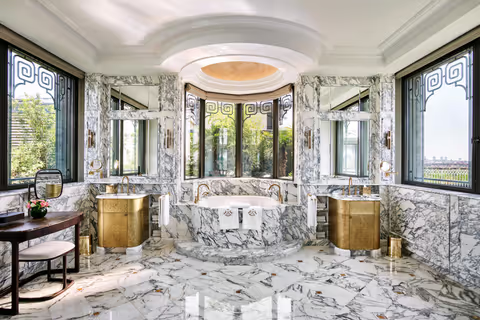
And then comes the time for major restorations, those of the XXIᵉ century. in Paris, the Hôtel de Crillon has reopened after five years of silence, awakened by an army of 250 artisans and 147 crafts. The Sienna and Portor marbles have regained their lustre, the woodwork their relief, the lounges their breath. A colossal undertaking carried out in the spirit of Monuments Historiques, but with the added requirement that every detail be both faithful and functional, capable of accommodating contemporary habits. We find Verrier passementerie on the hangings, mirrors with gold-leaf patina by Atelier Higué, and door handles designed by Fontaine, who created an original shade ("champagne nickel") found nowhere else. Underfoot, silk and wool carpets designed by Sabine de Gunzburg offer the softness of a painting to tread on. Shagreen, gadrooned marble, woollen velvet, hand-sewn embroidery: behind every detail is the trace of a French hand.
throughout all these emblematic worksites, we often come across historic signatures of French decoration: lelièvre, whose fabrics adorn the Carlton in Cannes and the Maison Chiberta in Biarritz, and Lalique, whose crystal and furniture add sparkle to the Villa René Lalique in Alsace and Château Lafaurie-Peyraguey in the Sauternes region. These houses are not mere suppliers, but style-setters, inscribing their gestures in the continuity of French craftsmanship.

Maison Chiberta @ Florian Peallat
But perhaps the most telling example is Le Meurice, opposite the Tuileries. Founded in 1835, this palace was already attracting British clientele with its unprecedented comfort, and its recent renovations have become a manifesto for French craftsmanship. Interior designers Lally & Berger and Charles Jouffre called on an entire network of workshops to revamp the suites: silk curtains fashioned by Ateliers Jouffre, delicate trimmings signed by Declercq, rugs woven by Manufacture des tapis de Bourgogne, inspired by the feathers the wind deposits in the paths of the nearby garden. On the walls, hand-painted hangings, sometimes dreamlike frescoes by Galatée Martin, or delicately patinated landscapes from the De Gournay workshops, give some rooms the illusion of a suspended garden. Every square centimetre is the fruit of a hand, patience and expertise. Here, the upholsterer's or painter's gesture becomes almost as important as the view of the Tuileries.

Maison Lelièvre at the Carlton Cannes © DR
French palace savoir-faire doesn't stop at the "major" arts. It even extends to the kitchen. Le Crillon, Le Meurice and Le Ritz have transformed their culinary know-how into an edible signature. Crillon's yuzu butter, Cédric Grolet's sculptural tarts at Le Meurice, Ritz's madeleines sold in little midnight-blue boxes: these are all creations that go beyond simple gourmandise. Each mouthful becomes a digest of French culinary heritage, reworked with the precision of a goldsmith. Here again, the gesture is paramount: that of the pastry chef who carves his pastry like a marker, that of the chef who emulsifies like a glassblower.
And then there's service, that intangible know-how that's not quite taught in hotel schools. France, which has made service a codified discipline, has also elevated the maître d'hôtel to the rank of principal player. The discreet gesture of the waiter who lines up glasses to within two millimeters, the attention paid to the position of a chair, the mastery of silence between two courses... all this is part of an invisible but essential choreography.
What officially distinguishes a Palace in France?
The official "Palace" distinction, introduced in 2010, recognizes this intangible dimension. To earn this label, which only a handful of establishments possess, it's not enough to have huge suites and a gleaming spa. You have to demonstrate a particular historical, aesthetic and heritage interest, and above all offer a bespoke service that borders on goldsmithery. The French Palace is therefore less a showcase than a workshop, less a setting than a succession of gestures handed down, repeated and refined.
In fact, every French palace is a concentration of trades in resistance. Resistance to global standardization, to the logic of international groups, to the oblivion of manual gestures. In a world where we dream of robot concierges and automated check-in, France continues to defend its upholsterers, gilders, florists and butlers as it would defend a rare language. And perhaps that's where the strength of its hotel industry lies.