






Les Riceys rosé, a rosé that isn't
A confidential appellation, a wine for both gastronomy and ageing, Les Riceys rosé has very little to do with the world of rosés. Discover this unusual gem from the Aube region.

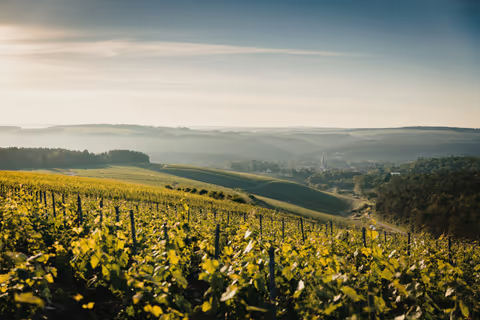
When you walk through Les Riceys, the scattered vineyards and steep slopes can be surprising and, very quickly, seductive.in southern Champagne, not far from Burgundy, the commune boasts the only three appellations: Champagne, Coteaux Champenois and Rosé des Riceys. Given the magnificent hillsides and slopes of up to 35 degrees, it's easy to understand why the parcels of land are not mechanized, and why the grapes are harvested by hand. A truly special vineyard, a rosé like no other, with an illustrious past, notablyprolific before the phylloxera epidemic, then recognized and preferred by a number of personalities at the turn of the century, such as the painter Renoir, who loved it.
A wine of parcels
Recognized in 1947, the appellation is today supported by some twenty winegrowers who give birth to this nectar that is still unfortunately unknown to too many consumers, despite its many assets. starting with its terroir, the village on the plateau between Champagne and Burgundy, composed of clay-limestone soils, in particular Kimmeridgian, as in Chablis.
The appellation area stretches from west to east, so you don't find the same clays; the "contrées" as they're called here, in other words the micro-terroirs, are very different, as are the many microclimates.les Riceys rosé " is a true parcel wine," explains Arnaud Gallimard, president of the appellation and winemaker of the estate that bears his name. We work our old vines, we prune shorter, we have low yields and, overall, we're more about concentration than volume. "Les Riceys rosé - a wine that's so complex and linked to its vintage that it's a misnomer - is made exclusively from pinot noir grapes, and is obtained through a maceration process that every winemaker knows the secret of.
As a result, the colors vary from one cuvée to the next, ranging from deep madder-red to light, airy hues. The same is true of the organoleptic palette: the range of aromas is quite broad, although there are some common characteristics, such as morello cherry, wild strawberry and the famous cherry aroma, which is quite widespread.

alexandre Bonnet
A terroir-driven rosé adaptable to any situation
The plot richness of Les Riceys rosé, coupled with its different expressions depending on the vintage, gives it another major advantage: that of being able to go in many directions in terms of food and wine pairing. As an aperitif, with white fish or meat such as duck, or with dessert, it is particularly appreciated by sommeliers and wine enthusiasts alike. A craze that extends beyond national borders, as evidenced by winemaker Arnaud Gallimard, who exports a great deal to Japan, his main international market: " With their curiosity and great knowledge of gastronomy, the Japanese really like it. And it's true that with the famous umami, we're not far from a perfect match. "
The natural balance of Les Riceys rosé, between Champenoise freshness and Burgundy elegance, is more reminiscent of a light red than a rosé.and its ageing potential makes it a true gastronomic wine, harmoniously combining a gourmet palate with structure. While it's true that today's wines are being sold younger and younger, this doesn't mean they can't be kept in the cellar if the connoisseur so desires! Rosé des Riceys remains a wine in a class of its own, both powerful and elegant, and the fact that in the space of three years, five new winegrowers who previously only made champagne have started producing rosé des Riceys suggests that the appellation still has a bright future ahead of it.
This article is taken from Gault&Millau Magazine #10. This issue can be found in our online store.