






The power of wood in exceptional spirits
Between production terroir, distillation, length of aging, choice of cask, cask size and spirit type, the combinations used to produce spirits are multiple and sometimes esoteric. For Alexandre Gabriel, owner of Planteray Rum, olfactory memory and instinct are paramount.

at the helm of Maison Ferrand, which he acquired in 1989, Alexandre Gabriel [opposite] has one thing in common with one of the Ferrand family's ancestors: a passion for barrel ageing. It is said that, decades ago, the Ferrand family mastered the art of aging cognac in different types of wood. A bygone era, however, when the Appellation d'Origine Contrôlée was granted in 1936, forcing producers to age cognac in oak barrels. This passion for wood, which he sees as a condiment, will be applied to gins and rums. While Alexandre Gabriel runs Maison Ferrand, he is also the owner of two brands, the first created in 1996, Citadelle gin produced in Ars [Charente], at Château de Bonbonnet, and the second, Planteray rums (formerly Plantation) in 1999.

Gin, a gastronomic perfume
When you arrive at Château de Bonbonnet, your eye is drawn to the plot of land opposite. These are our junipers ", explains Jonas Indesteege, rum brand manager at Maison Ferrand. Citadelle is not yet self-sufficient in juniper berries, which are harvested between October and November, but with eleven hectares of certified organic land, it's getting close. It is said that, in Saintonge, the hilltops were once covered with this plant, which is now coming back to life on its terroir. Once you've passed through the gates of the château, it's not your eyes that are titillated, but your sense of smell. Citrus scents waft discreetly from the orangery, home to dozens of varieties of lemon and orange trees used to produce part of the gin range. Some are then aged in new chestnut barrels, others in acacia, mulberry, cherry or oak containers that have contained pineau, cognac or tokay. This expertise has given rise to a short range (Original, Jardin d'été with an infusion of fruits and herbs, Rouge with an infusion of rhubarb and red fruits). As well as a number of limited editions, including one with gherkins and one that characterizes the remarkable expertise in wood essences, "No Mistake Old Tom", aged in different casks and to which toasted cane sugar has been added and which has undergone the same treatment. As Alexandre Gabriel puts it: " The choice of cask is a matter of instinct, and I've been doing it for over thirty-five years. You can make mistakes, but over time, you come to know and understand why a particular spirit thrives in a particular cask. "

Opportunity was the thief
Barrel-aged cane sugar is a perfect segue into the world of rums with Alexandre Gabriel, voted Best Master Rum Blender in 2012 at the Golden Barrel Awards in London, who in 2017 received the prestigious Outstanding Contribution to to Distilling from the American Distilling Institute before being honored with the title of " Ultimate and Most Admirable CEO of 2023 " by the Ultimate Awards, in recognition of his contributions to the craft of master rum blending. His adventure with rums began in 1999 when he created the Plantation brand, which became Planteray in 2024. His aim, as with cognac and gin, was to create exceptional spirits that reflect their know-how, terroirs and time, and to take them out of their traditional, global consumption patterns - the tonic for gin, the mojito for rum. It was during a trip to the Caribbean, when Alexandre was looking to sell second-hand barrels of cognac (with the aim of bringing cash into Maison Ferrand), that he discovered, on the spot, rhum agricole. Love at first sight! He knew all about distillation, terroir and ageing, but he also learned a great deal about shipping, barrel travel and the importance of roll. He returned to France and devoured all the information he could glean on the history of this spirit before buying his first bulk rums, which he had delivered by boat and in casks. In 2017, he acquired his first distillery, of which he was a customer: West Indies Rum Distillery, founded facing the sea in 1893, in Barbados, the birthplace of rum. In the process, he moved from merchant to distiller. Today, with the help and knowledge of Jonas Indesteege, Planteray distills or buys in Jamaica, Cuba, Saint Lucia, Trinidad, Guatemala, Perou, Venezuela, Paraguay, Panama, Belize, Guyana, Mauritius, El Salvador, Australia and Fiji, where the sugar cane is cut by hand.

breeding rather than aging
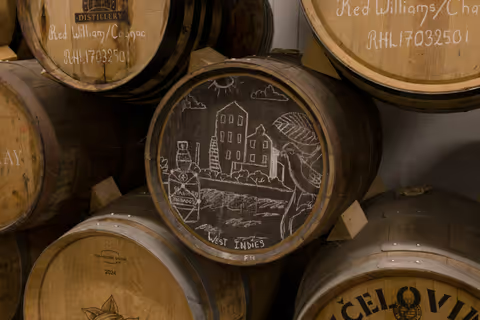
Around Cognac, Alexandre Gabriel owns storage facilities for the various rums he buys or produces. These are walls of casks, sometimes standing upright, sometimes lying down, with the year of distillation and the origin of the reused cask handwritten on them. Here, 2018 Fiji rum transported by boat in bourbon casks, then transferred to cognac casks where it will be aged for one to two years, and finally to port casks for one year before a final passage in stainless steel tanks. A thousand and one questions arise for the rum and spirits philosopher. Who, when and why use which species of wood? it's all instinct," replies Alexandre Gabriel, "but I can tell you one thing: the success of a perfectly aged rum is when you don't know what species was used. "For many spirits, there are great classics such as the re-used sauternes, banyuls, port or pedro ximénez cask. For Alexandre, the latter is the "golden retriever of the cask": " It licks you, it's gentle, never aggressive and, in the end, it will please you, but is that really what I'm looking for? "Jonas adds: " You shouldn't focus on the origin of the used barrel, even if the choice is not insignificant. Because, in reality, that's not all that counts. For rum, as for other spirits, in addition to the fundamental stages of cultivation on the plantation and distillation, you also need to know the degree of bousinage [this method consists of burning the inside of the barrel, NDLR] at the end of the distillation process.t, NDLR] at the barrel's birth, its size, the fact of taking micro-oxygenation into account, as wood is also a filter, knowing how it was transported empty, then full, then empty, and imagining the interaction that occurred between the solid and the liquid. "After several years in their first cask in the country of production, some rums need to be soothed after the journey; others need to be awakened, and it's at this point that the choice of essence comes into play. Out of the same 1,000-litre batch, half may be transferred to a marsala cask, while the other half will taste the ancient aromas of a pommeau. Is anything possible? Alexandre Gabriel asserts: " We're not stopping ourselves from continuing to research and study. We have rums aged in old barrels of Rivesaltes, Chardonnay, Pauillac and Moscatel. We have bottled rums from Fiji aged in Kilchoman casks. At the moment, we're watching how a rum placed in a small barrel bousiné with tonka beans evolves. "In short, the combinations are endless? Jonas Indesteege nods and concludes: " You see Pokémon card addicts looking for rare and valuable cards. For us, it's the same thing, except we're looking for rums and the barrels to blend them in. "
This article is taken from nᵒ 12 magazine. It is available in bookshops and on the Gault&Millau e-shop.