






Is white chocolate really chocolate?
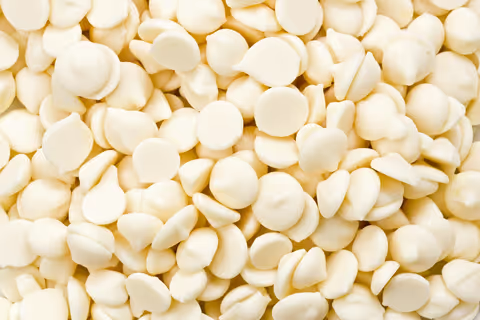
When it comes to cocoa, he gave up the paste but not the butter: white chocolate divides purists just as much as it delights food lovers. Between childhood memories and chocolatiers’ creations, this ivory-colored treat is embracing a new future.

Its story begins in 1936, when the Swiss company Nestlé decided to repurpose the surplus cocoa butter from its chocolate production. Sugar and milk were added to the cocoa butter—without fanfare—until the end of World War II… Its white chocolate bar with almonds, Alpine White, was a huge hit in the United States, and then, in 1967, the Galak bar was launched in Europe. Its milky and vanilla notes and its melt-in-your-mouth texture were particularly popular with children. Not to mention the packaging featuring Oum the dolphin, a character from the iconic 1970s cartoon that left its mark on an entire generation. Meanwhile, people in Spain, the UK, and Ireland know it as Milkybar.
This article is excerpted from Gault&Millau Magazine #15. It is available in bookstores and on the Gault&Millau e-shop.Since then, white chocolate had fallen somewhat out of favor, considered too fatty and too sweet. But that was without counting on certain pastry chefs, who have reclaimed it as an everyday ingredient, while chocolatiers have found ways to make it increasingly appealing and surprising.
Pros and Cons
Ivory in color, with a smooth and creamy texture: white chocolate is indeed a variety of chocolate! Except that it’s characterized by the absence of cocoa mass. This is obtained when the beans are ground and serves as the base ingredient for making chocolate, with the addition of cocoa butter, sugar, and milk in the case of milk chocolate. This paste can be used as is or pressed to separate the butter on one side and the powder on the other.
According to regulations, the cocoa content (cocoa paste and cocoa butter) must be at least 43% for dark chocolate and 25% for milk chocolate. White chocolate, on the other hand, must contain at least 20% cocoa butter and 14% dry milk solids (milk powder, condensed milk), of which at least 3.6% must be milk fat. The list of ingredients may also include emulsifiers (soy lecithin, rapeseed lecithin, etc.) and flavorings (vanilla). The term “chocolate” is therefore permitted for white chocolate made with cocoa butter. A point of disagreement between chocolatiers and chocolate lovers: some consider that chocolate without dry cocoa (cocoa mass) is not chocolate, but rather a sweetened preparation or a cocoa-based confection.
Cocoa butter: a fat unlike any other
Naturally present in cocoa (about 50% of the bean) and in white chocolate (at least 20%), the butter extracted from the beans is most often deodorized for use in the chocolate, cosmetics, or pharmaceutical industries. Once neutralized, it interferes as little as possible with brands’ recipes and their standardized flavors. Deodorization is achieved through various processes (water washing, thermal, or chemical treatment): the aromatic molecules in cocoa butter are volatilized to produce a stable, odorless substance.
“Cocoa butter is a magical fat. It’s one of the few that remains solid at room temperature. The ‘snap’ of a chocolate bar when you break it is thanks to the cocoa butter! ” explains chocolatier Marina Blanck Stroh, founder of La Brigaderie de Paris, who adds: “ It’s by holding it in your mouth and chewing it that chocolate reveals its full flavor, because the cocoa butter it contains melts at body temperature, which is 37 °C.” ” Marina Blanck Stroh is one of the few chocolatiers in France to work with non-deodorized cocoa butter. This butter has an aromatic complexity and character closely resembling the beans from which it is derived; she sources it from one of her cocoa producers in Brazil, who extracts it himself.
An Essential Ingredient in Pastry Making
For professionals, white chocolate is an ideal texturizing agent, helping to set certain preparations such as ice cream, mousse-based desserts, cream-based desserts, and even macarons, whose filling is often a whipped ganache—a mixture of cream, white chocolate, and sugar. Like any fatty ingredient, white chocolate also captures flavors and serves as a base for a wide range of flavors: vanilla, coconut, red berries, citrus, spices, dried fruits, or aromatic herbs. It also adds smoothness, creaminess, and excellent stability over time.
Most suppliers make white chocolate using deodorized cocoa butter. But Xoco (pronounced “choco”), which produces single-origin chocolates for professionals using cacao grown on its partner farms in Central America, has just introduced an innovative white chocolate containing 40% non-deodorized cocoa butter, along with cane sugar and milk powder, and no artificial flavors or vanilla. Its flavor profile may come as a surprise: particularly buttery and creamy, with hints of nuts like peanuts. The chefs at the Ostara Belleville bistro in Paris use it to make a creamy dessert served with a Campari granita, a Breton shortbread, strawberries, and pomelo.
Our favorite chocolate bars
- Hollyweed by Carrés Sauvages: a vegan white chocolate with cocoa butter, oats, cashews, orange blossom, and vanilla. carres-sauvages.com
- L’Or d’Amazonie by La Brigaderie de Paris: a golden chocolate made with non-deodorized cocoa butter from Brazil, roasted milk powder, and Amazonian spices (tonka bean, puxuri bean, and amburana seeds). labrigaderiedeparis.com
- 1001 Nuits de Songes et Cacao: a plant-based white chocolate made with non-deodorized cocoa butter from Peru, almonds, and orange blossom.