






The Norman whelk, a small shellfish with big stakes
The discreet star of seafood platters, the whelk from the Bay of Granville tells a singular story: that of a local, selective and respectful fishery, now awarded the IGP label. Behind its spiral shell, battles are fought to preserve a resource.

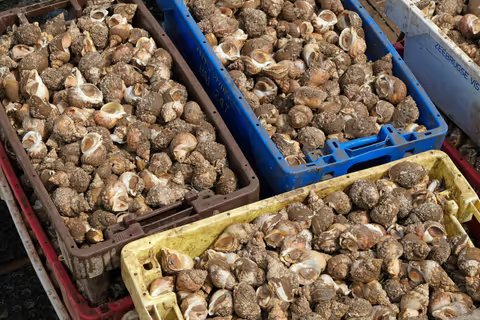
On the quays of Granville and other ports in the bay, traps are still stacked, despite doubts and headwinds. This is the heart of the whelk fishery, the firm, iodized marine gastropod for which Normandy is famous." When I first set sail, it was to validate my Capitaine 200 Voile, I followed my brother to i followed my brother into the whelk fishery... and stayed there," says Johan Leguelinel, now co-chairman of the Manche Ouest whelk commission. Fourteen years later, he continues to go out to sea, " attracted by a living profession, never identical, with its changing conditions and this permanent link to the ocean ".
A fishery that sustains the resource
The Norman whelk is a shellfish unlike any other. Unlike the oyster or the scallop, it doesn't filter the water: it feeds on marine worms and small molluscs. They are fished exclusively with traps, a selective method that has little impact on the seabed. It is this demand for quality and respect for the environment that has earned the Granville whelk its PGI status.
" Our challenge is to perpetuate the resource and the activity. We've taken measures, and we'd like to ask the French government and the European Union for a fleet exit plan to try and reduce the number of boats in operation. at present, this is one of the levers that seems most relevant to us," emphasizes Johan Leguelinel. Climate change, with its rise in water temperature, is nevertheless upsetting the natural balance. " The resource has taken a big hit. Our efforts are paying off, but it's not enough. This is an animal that has always protected itself from the heat by burying itself during the summer, waiting for the water to cool before emerging. As the years go by, the sea stays warmer for longer and longer, making it impossible for it to survive. "
The Bay of Granville is still home to an active but fragile fleet, with almost half of its vessels now up for sale. The decline in resources, combined with rising costs and market fluctuations, is putting the industry under pressure. Contrary to popular belief, the whelk is not an endangered species. Quotas, seasonal closures and scientific monitoring ensure its sustainability.
" We often hear that we've overfished. But right from the start, we limited our catches and restricted our fishing effort. The whelk suffers above all from the climate and the market ", insists the fisherman. If the industry is fighting, it is also to maintain the whelk's place on the table. Long popular, it now suffers from a sometimes aging image and a less accessible price. Yet it remains a must-have on any seafood platter. Cooked in court-bouillon and served with a homemade mayonnaise, it unfolds a unique marine flavor. Every spring, the seaside resort of Pirou lives to the rhythm of its famous whelk fair. This convivial event brings together sailors, locals and curious onlookers for tastings and entertainment. Proof that the little shellfish has lost none of its power to bring people together.
Behind the discreet silhouette of the whelk, a whole region tells its own story: a Normandy attached to its sea and its traditions. For Johan Leguelinel and the fishermen of La Manche, the future remains open: " I've been self-employed for ten years, and I still manage to make a living from this trade. It's a great success. "As long as there are whelks and sailors to catch them, the story will go on.
Did you know? Fresh whelks can be enjoyed all year round... except in January! That's when they come to a biological standstill, dedicated to reproduction and egg-laying.
This article is taken from the Normandie 2026 guide. It is available in bookshops and on the Gault&Millau e-shop.