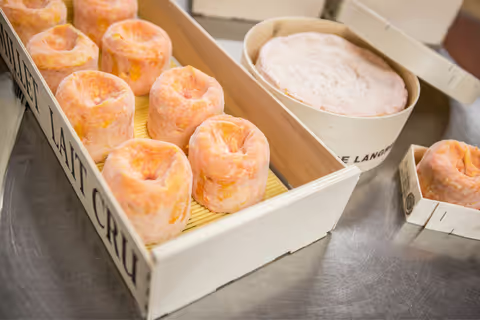
Langres AOP: The Remillet family, the last to make it with raw milk
Marie Remillet, a 32-year-old cheesemaker, inherited the Langres cheese-making tradition. Together with her father, uncle, and cousin, she continues to write her family’s story in Genevrières, centered on the only AOP cheese from Haute-Marne.
In the beginning, there was a cow, given to Geneviève and Jacques Remillet as a wedding gift shortly after World War II. Two more cows joined the modest herd of the farming couple, who had settled in Genevrières, in the heart of a lush dairy region where the Marne, Aube, and Meuse rivers have their sources. The farm’s milk was then delivered to the village cooperative to be processed into Emmental cheese. The story might have ended there had it not been for Sylvain and Jean-Yves, two of the couple’s six children, who took over from their parents in 1992 and expanded dairy production. To add value to their milk, the two brothers—whose herd grew over the years—began processing their milk themselves the very next year into faisselles, yogurt, and other fresh products. They also took charge of marketing the products.
A Little-Known AOP
In 1991, a small revolution shook up the world of dairy farmers in Haute-Marne. Langres cheese, which originated in the 18th century and was on the verge of disappearing before 1930, was awarded the prestigious AOC designation. In addition to the proud medieval citadel, whose ramparts have overlooked the Langres plateau for centuries, this rural and sparsely populated region has just gained a new crown jewel—this time, a culinary one. The Remillet brothers embarked on the Langres AOC venture around 1995. They were joined by two of their children: Édouard manages the farm and its 115 Brown Swiss cows—one of the three breeds authorized by the designation—alongside his father, Jean-Yves. Marie, Sylvain’s daughter, has been assisting him at the cheese dairy since 2015. To date, the farm produces 1.3 million liters of milk per year and processes one million liters of it—85% into Langres and 15% into fresh cheeses. The Langres AOP, granted in 2012, is one of the smallest cheese AOPs in France, with an annual production of just 654 metric tons. Of the three cheese dairies that produce it, only the Remillet dairy offers a farm-made cheese (made with milk from their own farm).

Marie Remillet, head of production since 2018, is particularly committed to the quality of her cheeses. She says she doesn’t aim to feed the world; rather, she seeks to offer a moment of pleasure with a cheese that has a distinct flavor and embodies a unique identity and history. To ensure this quality, nothing is left to chance, from feeding the cows to packaging. One telltale sign: the Remillets are the last to offer raw-milk Langres AOP, despite the drastic health and safety requirements this entails. In the cheese factory, more time is spent on cleaning than on actual production! As for the requirements of the AOP specifications, they are far exceeded. For example, while dairy cows’ feed must consist of at least 80% feed sourced from the appellation’s designated area, this figure rises to 90% at the Remillet farm. Similarly, the mandatory aging period of at least two weeks is extended to 30 days.
From Pasture to Table
Langres AOP is a soft cheese with a washed, orange-colored rind. It has a distinctive dome-shaped form, with a hollow in the center called a “fontaine.” It comes in three sizes: small (150–250 g), medium (250–350 g), or large (800–1,300 g), with the latter sold by the slice at dairy shops. Production begins early in the morning, as soon as the milk arrives from the farm, by adding ripening bacteria to the warmed milk, followed by renneting. The curd, cut into 2-cm cubes, is placed in cylindrical molds and then turned over to aid draining. It is during this step that the central well forms. After draining overnight, the cheese is removed from the molds and lightly salted by hand to preserve the milk’s flavor. During ripening—which allows the yeasts to develop—the cheese is not turned. It is rubbed by hand and moved every day to take full advantage of the variations in temperature and humidity between the different areas of the cellar. After 30 days, it is sold to wholesalers and large and medium-sized retailers.
In addition to a chalky center, a good AOP Langres should have a runny edge beneath the rind when cut. Marie Remillet recommends letting it sit at room temperature for 3 to 4 hours before tasting to bring out the aromas. To pair with it, skip red wine or hard liquor and opt instead for a dry white wine or an amber beer, such as the Choue Rousse from Vauclair, a family-owned brewery in Haute-Marne that partners with the cheese shop. Or, in other words, how to enhance an exceptional product with a beverage full of character.
This article is excerpted from the Grand Est 2027 guide. It is available in bookstores and onthe Gault&Millau e-shop.