






The vine climbs northwards
Cartographers specializing in the representation of wine-growing France have their work cut out for them. For some years now, vines have been spreading beyond their traditional geographical boundaries, gradually making their way northwards. Here's an overview!

Don't be fooled into thinking that Brittany, Normandy, Île-de-France and Hauts-de-France have winegrowing "oceans" as far as the eye can see. Vines are invading their landscapes in small, impressionistic touches, but they're becoming less and less discreet. Should we be surprised? After all, wine is produced in Belgium and southern England! And then, when you read historical works, you quickly realize that vines were once very much present in regions that until recently were thought to be inhospitable.
Between the IXᵉ and XIVᵉ centuries, its cultivation was very common in Brittany, for example, and not only - far from it - for the liturgical needs of monastic orders. It was in Haute-Bretagne - the eastern part of the Armorican peninsula - that it developed mainly, in the Rance valley and in the Pays de Redon encroaching on the Basse-Bretagne part through the Rhuys peninsula. Between literary sources, archaeological finds and toponymic legacies, the clues are very serious and concordant! There is less evidence for the period following the Middle Ages, marked by a sharp erosion of winegrowing in Armorica and Normandy.
In the Île-de-France region, the decline came later: at the end of the XVIIIᵉ century, Argenteuil was still France's largest wine-growing commune, with some 1,000 hectares of vines. The development of the railroads, which enabled the circulation of competing wines of better quality, was undoubtedly one of the causes of the gradual disappearance of vines in Brittany, Normandy, Hauts-de-France and Île-de-France.
The role of climate!
what, in this day and age, is responsible for the return of vines to these regions? Global warming, of course, to which we attribute a thousand evils and a thousand virtues. As the thermometer climbs, it's easier to ripen grapes in northern latitudes. Hard to deny, but a little simplistic. First of all, as much as warming, we're talking about climate change. This upheaval is accompanied by brutal meteorological phenomena - heavy rainfall, drought, hailstorms and so on - which could cause serious damage to our vines.le among others - which could cause difficulties for winegrowers in Normandy and Brittany, as well as for their colleagues in the rest of France. Secondly, there is no guarantee that climate change will not eventually lead to a cooler climate: the Gulf Stream current could change course and no longer "lick" the Breton coasts, whose climate it softens.
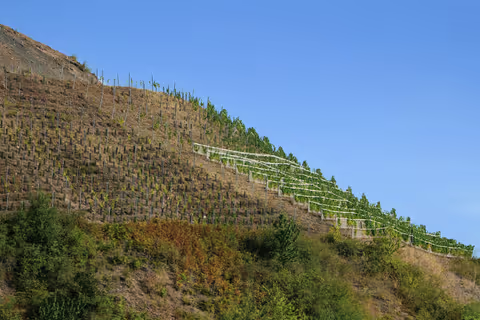
Further north, Laurianne Carbonnaux, a winegrower from the Terres de Grès estate in the Pas-de-Calais region of France, also speaks of a "disturbance": "We're sailing a bit close to the wind on this subject, and we're trying to manage the excesses. "But for her, there's no climate limit to making wine in her region. President of the Association des Vignerons de Normandie, Édouard Capron created Domaine Saint-Expédit, in Freneuse (Yvelines), on the steep slopes of the Seine valley. He agrees: " Producing wine is all about adapting to a place, a terroir, finding the right grape varieties, the right winemaking practices, so that we can make wines that are different from elsewhere, with a distinctive character.it may sound crazy to make wine in Normandy, but the climate isn't a problem," says the man who was wrongly predicted to face hell when it came to diseases such as mildew.

guy Saindrenan
The planting rights revolution
The hypothesis of global warming or climate change as a factor in the renaissance of viticulture in Brittany, Normandy, Hauts-de-France or Île-de-France is therefore insufficient at the very least. For it would have been impossible without the liberalization of planting rights. To put it plainly, from the 1930s onwards, winegrowing zones were delimited in France outside which it was forbidden to plant, produce and market wine for professional purposes. In 2016, this situation was rendered obsolete by a European decision. Since then, regions that had been off limits to winegrowers for over ninety years have been perceived as "Eldorados" by people wanting to set up in business: people with a passion for wine, young people with experience in the wine industry, or farmers looking to diversify their business, like Laurianne Carbonnaux. She became a winemaker after completing a BTSA (Brevet de Technicien Supérieur Agricole) in viticulture and oenology, as well as an internship at Domaine Didier Dagueneau in the Pouilly-Fumé appellation, in the Nièvre region. She is also a member of the Association des vignerons des Hauts-de-France, like fifteen other independent winegrowers.
Not Sunday winegrowers
Much more than just planting three or four vines for fun or reviving a forgotten heritage, this new generation's ambition is to create and perpetuate genuine wine estates. A case in point is Domaine La Bouche du Roi, created in 2017 in Davron, in the Yvelines region: a figurehead of the Ile-de-France vineyard, its wines are winning over the most prestigious restaurants in France and the United States. In Normandy, some thirty winegrowers are currently planting or have planted, and around five have already bottled wines. In Brittany, there are around fifty professional wineries. barely a dozen estates have already made and sold wine: " In 2025, there will be around fifteen of them harvesting their grapes, and even more in 2026 and 2027, as many plantations will then come into production ", promises Loïc Fourure. Co-president of the Association des vignerons bretons (AVB), himself an organic winegrower in Theix-Noyalo, Morbihan, he insists on the need to federate, to exchange, transmit, discuss and gain visibility.
Together, AVB members have succeeded in obtaining administrative recognition for their sector. Together, they also drew up a charter emphasizing a number of strong points: short circuits, biodiversity, good farm management and the non-use of synthetic phytosanitary products.
Virgin land
In these lands long forgotten by the vine, everything remains to be done. Virgin soil. Almost a blank page. It's dizzying, inspiring and fascinating all at once. Each winegrower continues to become intimately acquainted with his terroir, refining his choice of grape varieties - chardonnay, chenin, grolleau, pinot noir, pinot meunier, pineau d'Aunis, cabernet, savagnin, etc. - and his cellar practices to ensure the best possible quality. -Some of these wines are already proving popular with wine merchants, restaurateurs and even gourmet sommeliers. This is quite a promise, since the winemakers will gain in experience, and their vines, as they "age", will lend more and more depth to the wines. What remains to be done in these regions is to structure a genuine wine industry, with its various service providers, wine analysis laboratories and so on. The winegrowers, on the other hand, are already there, and will be much more numerous in the years to come.