






Karin Nebot: "We need to desacralize caviar consumption"
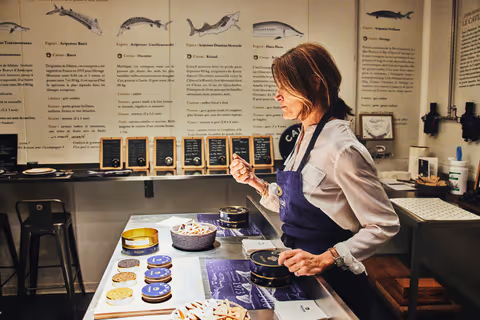
Co-director of Kaviari, the company founded by her father, Karin Nebot imports, refines and supplies caviar to chefs. At the same time, she is working to extend consumption of the precious sturgeon eggs to the general public in her Kaviari Delikatessen grocery stores.
Kaviari was created in 2001, when wild caviar was still available. How did it begin the shift to farmed caviar?
Karin Nebot: When the end of wild caviar marketing was decreed in 2008, it was a real turning point for the company. We had to learn to work with farmed caviar farms to obtain our supplies. Some had already anticipated the changeover, not only in France but also in Europe and even China. As a result, we became breeders and refiners of farmed caviar.
What does the job of refiner involve?
K.N. : To select and store caviar, we have set up a 3,000-square-meter laboratory in Ivry-sur-Seine [Val-de-Marne]. We also have a maturing cellar where the eggs are left to mature for six to eight months, just long enough for the caviar to develop its full flavour. It's important to know that when sturgeon eggs are picked, once they've been rinsed and drained, they don't really have any taste: it's the salt absorbed by osmosis that modifies the characteristics of the grain membrane, flushing out the water and giving the caviar its flavor. The caviar then needs time to mature. Without this, the caviar will have a strong salt taste and no long finish. Aging between 5 and 10 tonnes of caviar a day (out of over 30 tonnes sold a year) in cold chambers, as we do, requires a significant financial outlay that not everyone can afford.
The French are the second biggest consumers of caviar after the United States, but the biggest per capita. How do you explain their fondness for caviar?
K.N.: France remains the benchmark for gastronomy, and our chefs are world-renowned. They are our ambassadors to their customers, our relays. That's why we have to take great care of them, because they all have different tastes. Each chef comes at least once a year to meet Bruno, our caviar master, or his son Valentin. Together, according to their menu, they define their specific needs: grains of a particular species, lighter or darker, more or less iodized.

Should caviar remain an exceptional product, or should its consumption be democratized, as has happened with salmon and foie gras?
K.N.: It has to remain a dream. The tins of caviar you find in supermarkets today are often the end of a batch, which is not exceptional in terms of taste. Caviar will never be a mass-market product for one simple reason: it takes at least seven years for a female to give her first eggs. There's an incompressible price below which we can't go because of production costs. On the other hand, we need to desacralize caviar consumption. We're doing this at Kaviari by offering small grammages in our Kaviari Delikatessen boutiques.15-gram boxes of osciètre, or ready-to-eat meals consisting of a spoonful of caviar and a shot of vodka. In our boutiques, you can treat yourself to 30 grams of caviar and a glass of champagne.
In February 2025, Aquitaine caviar was awarded a Protected Designation of Origin (IGP) to promote French know-how. What do you think?
K.N.: In all honesty, I don't think it's very relevant to reserve an appellation for a particular geographical area, because there are good farms everywhere. I'm thinking of Italy and Poland, which produce excellent caviar. Not to mention China, which produces by far the best caviar in the world, with extraordinary batches. Fortunately, there are other ways of certifying the quality of a caviar than its geographical area. The real criteria are irreproachable water quantity and quality, a choice environment and good nutrition. Caviar also includes different species such as Acipenser baeri or osciètre, Sinosturio schrenkii and Sinosturio. Dauricus, two species endemic to the Amur River that produce extraordinary Chinese caviar. It's no coincidence that more than half the caviar we sell today comes from China.
Chinese caviar is sold at the same price as French caviar in gourmet restaurants. How do you explain this, when labor costs, economies of scale and the common practice of dumping in China should make Chinese caviar much more competitive?
K.N.: The " Schrenkii dauricus " is a large sturgeon that requires ten, twelve or even fourteen years for the female to obtain her first eggs. As a result, we buy Chinese caviar at the same price as French, Italian or Polish caviar, or even more expensive, because we select the best caviars for our chefs. The Chinese aren't crazy; it's not in their interest to sell caviar at low prices. Those who claim otherwise, and think that we're taking advantage of the situation to"margin" on it, are wrong.
Four years ago, investment company Olma Luxury Holdings acquired a majority stake in Caviar House & Prunier. A proposed merger with Caviar de Neuvic was mooted some time ago. Is Kaviari destined to remain a family business?
This article is taken from Gault&Millau magazine nᵒ 12. It is available in bookshops and on the Gault&Millau e-shop.K.N. : I represent the second generation with my brother Laurent. If Kaviari were to change shareholders tomorrow, the company would have to remain a family business, meaning that my father, my brother, our partner Raphaël Bouchez and I would have to retain a majority shareholding. Our special relationship with the chefs, which is essential, must continue. We've built up a bond of trust with them, and it's important not to call it into question. We also have lots of development projects that don't necessarily require a fund. From the outset, my father has run Kaviari as a"good father", and the business is healthy.