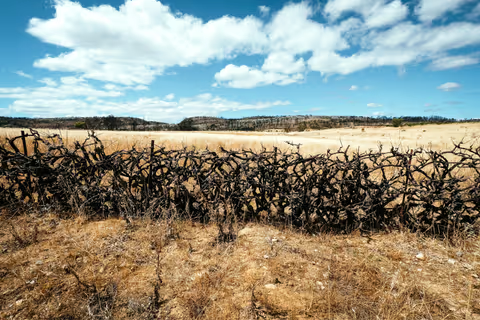
Fire in the Corbières: One Year Later, What Remains of the Vineyards?
On August 5, 2025, a fire—likely sparked by a cigarette that hadn’t been properly extinguished—broke out in the village of Ribaute in the Corbières region of the Aude department. Within two days, it had spread across 17,000 hectares, burning everything in its path—including vineyards, which usually act as a natural firebreak. A year later, the vines and winemakers are slowly getting back on their feet.
In late July 2026, smoke from the massive wildfire raging in Gironde drifted over the heads of the Corbières winemakers: “I thought we’d never have to go through that again in France, that it was the last of its kind,” says, horrified, says Olivier Verdale, a winemaker in Saint-Laurent-de-la-Cabrerisse and a volunteer firefighter for many years, whose village was surrounded by the raging inferno. In total, “the” fires—since three others had broken out before the Ribaute disaster—destroyed 1,000 hectares of standing vineyards out of the approximately 8,000 hectares that make up France’s fourth-largest appellation. “Usually, the vines don’t burn and even serve as a firebreak,” explains Olivier Verdale. Under normal conditions, a fire merely skims the edges, finding little highly flammable fuel in these hardy vines and on open ground. But in 2025, the fire encountered vines dehydrated by several years of drought—less than 200 mm of rain—which had become easy prey for the flames.
Starting from Scratch
The disaster transformed the landscape, leaving ashen hills dotted with charred stubs— the remnants of burnt-out pine trees—and sparse vineyards, even though the abundant winterrainfall , a windfall of1,000 mm, have allowed the survivors to flourish beyond all expectations.