They both appeared on "Top Chef" 12 years apart—here's what's changed
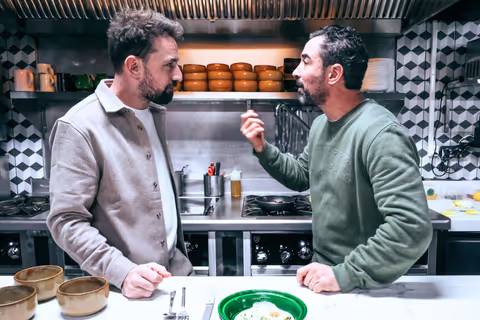
An iconic contestant, Pierre Augé made his first appearance on *Top Chef* in 2010. At the time, Thibaut Spiwack was still just an apprentice at Lucas Carton in Paris. He wouldn’t experience *Top Chef* until twelve years later. In the meantime, the show—now a cult classic—has become a benchmark in the industry. A conversation between the veteran* and his dedicated protégé.

Thibaut, did you follow Pierre’s journey back when he was on theshow?
Thibaut Spiwack: Yes , because I watched every season of Top Chef until I competed on the show in 2022. I was passionate about all cooking shows, especially *Oui chef!* starting in 2005. That was the year I enrolled in culinary school.
Pierre, looking back, what did the show bring you?
Pierre Augé : My first appearance gave me credibility and validated the culinary path I was taking. I felt ready to open my own restaurant. When I competed, I was battling against myself...The guy next to me was my friend. That show is amazing! It pushes you to go further. Back then, there wasn’t the concept of competing teams facing off against each other. I can’t really see myself in that format. I don’t think I would have enjoyed it as much.
You have at least one thing in common. You didn’t sign up on your own—M6 spotted you.
T. S.: The network casts people today partly through social media. That’s how they found me.
P. A.: As for me, I was spotted when the Omnivore festival [in Paris] named me France’s most creative young chef. I’d also already worked at some great restaurants, with legendary chefs like Éric Frechon, Frédéric Anton, and Pierre Gagnaire, which reinforced the interest [of the M6 teams].
What motivated you to participate?
P. A.: I like competitions, but I couldn’t care less about TV! Back then, it was Guy Legay, the former chef at the Ritz, who judged the cooking challenges during the selection process. As for me, I showed up with my hands in my pockets! (Laughs.)
T. S.: We were aware that we could capitalize on the “Top Chef” brand. But we still had to know how to use that springboard. When I participated, my restaurant, Anona, had been open for three years. Business was going pretty well, with a 70% occupancy rate. As soon as the first episode I appeared in aired, we started taking reservations three months in advance. That allowed me to create jobs, growing from 6 to 19 employees in barely a year.
Did you both have a financial goal?
T. S.: I wanted to give myself that option, while fully aware that I could completely bomb on the show. But, yes, my participation was a marketing tool, especially to talk about my plant-based concept and my commitment to this type of cuisine.
P. A.: At first, after my first time competing, I looked for a restaurant in Paris, but I ended up returning to Béziers because I hadn’t found a space that really spoke to me. So I took over the family restaurant with my wife in 2010. We increased our seating capacity from about fifty to a hundred per seating. When you become the owner of your restaurant’s property, you have to make your business profitable. I’m not just a chef. There are employees to hire, unexpected expenses… You know what I mean, Thibaut, since you’re an owner-chef too.
T. S.: That ’s right—the strategy is different. We face the same challenges. When you’re an owner-chef, you’re as much a cook as you are an accountant, a psychologist, a janitor, and a career counselor!
The “Top Chef” label also brings sudden fame, doesn’t it?
P. A.: In 2010, we had absolutely no idea what to expect after the show aired. On the street, I had no idea what was going on when people asked to take a picture with me. I’d think to myself, “Are you crazy or something? I’m not a singer!”
T. S.: Unlike Pierre, I was aware that fame was a consequence. But if you stay a nice guy, it’s not a bother. Except in private moments, like when I was photographed in the sandbox with my 2-year-old son.
In your opinion, do you have to win Top Chef to be successful?
T. S.: No. Take Mory Sacko, for example, from Season 11. He only finished sixth, and look at his success! As for me, I wasn’t aiming for the win. It’s not always the winners who’ve had the biggest impact—except for Pierre. But, well, he cheated—he competed twice! (Laughs.)
P. A.: For me, the two finalists are the ones who deserve it the most.
So is the experience worth it, despite having to live in a hotel with the other contestants for the two months of filming, far from your loved ones?
P. A.: I couldn’t stand being cooped up! Every night, I’d go out for drinks until 2 a.m. and invite the others to come along! (Laughs.)
T. S.: It’s because of you that the production team put a curfew in place—otherwise we would’ve been fired! (Laughs.) They also told us not to check social media during filming to avoid comments from “haters.”
P. A.: Back then, Instagram didn’t exist yet. Social media didn’t have the influence it does today. In 2010, we were filming a “grandma’s kitchen” segment. The equipment was basic. We had a blast chiller for 15 people. Now, the contestants have planchas and Kamado-style grills. For us, it was the old-school way!
T. S.: It’s true—we even had liquid nitrogen during the challenges!
P. A.: That also reflects how cooking has evolved. Even between 2010 and 2014, there was a difference—if only in the importance placed on creating so-called “Instagrammable” dishes. That forced me to improve my plating.
T. S.: Before Instagram, to discover fine dining, you had to eat at top restaurants to really know what a dish by Ducasse or Bocuse looked like. With social media, cuisine is evolving much more quickly. Since customers know what others are doing, you, as a chef, have to at least keep up with the rest. If you’re making what was trendy two years ago, you’re out of touch. Social media has changed French cuisine.
Do any of your customers still make reservations because of your “Top Chef” cap?
T. S.: Yes, every day! Not a day goes by without someone asking me to sign the menu.
P. A.: Cooking has become a trend, when it’s really a necessity first and foremost. People tell me, “You haven’t changed a bit!” But I was already 30 back then! (Laughs.) Still, customers don’t come just for that. It’s mainly about the great value for the money!
Do the menus at your respective restaurants feature dishes you created during the competition?
P. A.: I don’t really like to repeat what I’ve already done, except for the apple blood sausage I made for the kids’ challenge.
T. S.: The signature dish of my restaurant, Anona, was the one I served during the very first challenge. Built around snails and herbs, it’s a dish I used to highlight the least polluting land-based animal protein.