






Gaillac Withstands Climate Change: Can These Old Grape Varieties Save the Wine?
In the Tarn Valley, Gaillac is the Gallic rooster— the gallinaceous bird, etymologically speaking, but also the pride of an Occitan vineyard founded in the Gallo-Roman era that resisted invaders with its native grape varieties, which have become the best defense against climate stress and the globalization of tastes.
The 5,000-hectare appellation, which has held AOC status since 1938 for whites and 1970 for reds, has never fully succumbed to the international grape varieties introduced after the war on its generous slopes, which are more clay-rich than limestone. Sauvignon, Muscadelle, Merlot, Cabernet, Syrah, and Gamay have always had to coexist in this hedgerow-dotted landscape, dotted with hedges and copses, alongside the region’s native grape varieties—Mauzac, Loin de l’Œil, and Braucol.
Do these old varieties have a future?
Since the 1970s, over three generations, the Plageoles family has helped revive a handful of other grape varieties that had all but disappeared: Duras, Prunelart, and Ondenc. These varieties—saved by Marcel, documented by Robert (author of three books), and widely planted by Bernard since 1983—have gradually regained ground before reclaiming, along with the first three, their status as primary grape varieties. The appellation’s specifications, revised in 2017 and 2025, require them to make up 70% of the blends, relegating international varieties to a secondary role—with exceptions in a range of seven wines: dry whites, sweet whites, late-harvest wines, sparkling wines, rosés, reds, and primeurs.
Among Gaillac’s six grape varieties, two are shared—Mauzac with Limoux and Braucol or Fer Servadou with Marcillac in the Aveyron—and four are unique to France: Loin de l’Œil, native to the region for five hundred years; Ondenc, thought to be lost throughout the 20th century, which found refuge here after disappearing from Bordeaux and Cognac; Duras, related to Savagnin; and Prunelart, an ancestor of Malbec and a cousin of Fronton’s Négrette. But the struggle for identity that has shaped Gaillac is coming head-to-head with climate change. Do these old grape varieties have a future? They have withstood “globalization,” but will they be able to withstand the scourges of the 21st century—drought, heat waves, and fungal diseases?
Upheaval in the Vineyards
Winemakers are observing the increasingly evident difficulties faced by their white grape varieties—Ondenc, Loin de l’Œil, and especially Mauzac—which suffer from a significant lack of acidity, whereas the local “quilles” are renowned for their liveliness. “The reds—Braucol, Duras, and Prunelart—are faring better,” observes Olivier Yobregat, a grape variety specialist at the local branch of the French Institute of Vine and Wine. They remain fresh, with subtle tannins that produce rich, fruity, and spicy wines. Faced with the impending climate changes in Tangier, the appellation has set out to find complementary grape varieties adapted to the new conditions without compromising the wine’s organoleptic profile. Late last year, it adopted five varieties of interest for adaptation (VIFA), authorized for experimental use. “Gaillac is neither the first—Bordeaux, starting in 2022—nor the most radical—Champagne and Provence have made bolder choices. But its approach will be landmark in terms of collaboration and comprehensiveness,” says Olivier Yobregat, who led the study. “The winemakers outlined their needs, ranked their priorities, and wanted us to study all 200 possibilities in the catalog before tasting 25 finalists. ” In the end, they selected four whites (one Portuguese, one Hungarian, and two long-forgotten Gaillac varieties) as well as one red (Jurançon Noir), “chosen for their resilience to drought.” Local origin was a key factor for the Verdanel and Felen, indigenous white grape varieties “that checked all the boxes.”
On the other hand, they rejected the new disease-resistant hybrids—PIWI, RésDur 1, and 2… “In terms of taste, we didn’t find anything that quite hit the mark,” says Nathalie Vayssette, co-president of the appellation, sidestepping the issue. According to Olivier Yobregat, “they faced strong internal opposition in this vineyard region, which has built its reputation on old grape varieties.” As a result, “the appellation is endorsing traditional methods of disease control, using chemical or biological treatments.” Conclusions will be drawn in ten years, provided the program gets off the ground: “Currently, we’re uprooting far more vines than we’re planting,” points out Olivier Yobregat. Gaillac’s vineyard area has shrunk by 30% over the past two years—a drastic decline. “The industry’s severe economic difficulties are hindering the search for adaptive solutions.”
Taking the Initiative
However, a handful of organic and biodynamic estates—members of the activist association Terres de Gaillac—didn’t wait for their institutions to take action. Bernard Plageoles reintroduced the Verdanel variety on his estate as early as 1998. He provided cuttings to anyone interested in replanting this native grape variety “with immense potential”: there are now about ten hectares of it in the vineyard. “But simply planting old grape varieties isn’t enough to solve the problems,” the winemaker laments. We need to stop using herbicides and chemicals, focus on soil health, put an end to destructive tilling, and nourish the soil with grass and vine shoots. The industrial model is dead, and not everyone has figured that out yet.” At the estate, twenty hectares are farmed organically on the right bank of the Tarn, the ideal terroir for Mauzac—white, rosé, green, black, and red—a veritable rainbow—the vines are not trellised but trained in the goblet style, “as was once the practice everywhere south of the Loire. The goblet acts as a parasol.” Bernard Plageoles is now experimenting—with a row of trees every ten rows of vines—with the forest’s self-regeneration cycle, where deciduous leaves decompose on site into humus.
The Truth of the Grape Variety
For Grégory Aurel, an outsider to the appellation who sells his 10,000 to 15,000 bottles as “Vin de France,” the syndicate deserves credit for raising the issue, but “the discussion is bogged down by the inertia of old estates trapped by the economic crisis.” He knows what he’s talking about, as he is also a banker at Crédit Agricole. This dual-career professional cultivates four hectares of L’Œil and Syrah at the organic Pech del Cel estate—soon to be five, with three young vineyards planted with Verdanel, Duras, and Mauzac Rose. “It’s a gamble. But I believe native grape varieties are best equipped to withstand challenges, precisely because they’re from here and have been in symbiosis with the environment for centuries. Provided, however, that they’re cultivated properly. ” This means keeping yields modest so as not to exhaust the vines—or to artificially fatten them. Pech del Cel is located on the Cordais Plateau, the most limestone-rich and least productive area, but the most conducive to white wines. Grégory Aurel is a staunch advocate of Loin de l’Œil here: “A fresh and aromatic grape variety, remarkably versatile, capable of producing—like Mauzac—dry, sweet, oxidative, and sparkling wines… Here, at 30 hl/ha—just like my great-grandfather did in the 1920s—we’re getting closer to the true nature of the grape, especially when vinified with native yeast.”
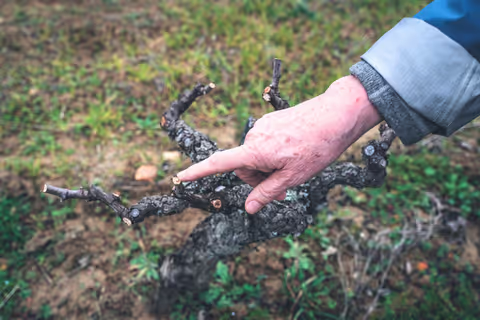
For Grégory and his wife Laure, there is no salvation for Gaillac outside of native grape varieties. But when the climate cuts the vines’ lifespan in half and threatens the harvests to such an extent that there isn’t even any wine left to bottle, we have to change the way we cultivate them. To that end, Grégory has set out to modify the Guyot pruning method he inherited from his father—which “causes sap blockages”—and convert it to double cordons: two arms extending on either side of the trunk, and branches spreading out like a candelabra that bear well-ventilated clusters, less susceptible to disease. The same line of thinking regarding the base of the vine—at the point where it joins the rootstock—led him to opt for in-field grafting: a demanding and costly technique—three times the price and a five-year wait before the first harvest—involving planting the rootstocks first, in this case the Sicilian 140R variety, known for its resistance to water stress—and allowing them to develop deep roots before grafting the fruit-bearing variety in the open field, two years later—a delicate operation performed by specialists in the T-Bud technique, known as the “Mexican” method. It is a vigorous rootstock that receives the scion. At Pech del Cel, the best defense against global warming is prevention: fostering natural resistance and warding off disease.
The same philosophy is embraced by the neighbors at Domaine de Cantalauze. Pierre-Olivier and Pauline Laurent returned in 2013 to the estate founded by Pierre-Olivier’s parents in 1982—agricultural engineers who came to pursue their dream of organic farming. For him—an oenologist who spent his career as a winemaker in the Southern Hemisphere and for major corporations—the wide variety of native grape varieties and their diverse genetics are a guarantee of resilience: “In the face of adversity, there will always be one that fares better than the others.” At Cantalauze, every effort is made to strengthen the vines naturally. The 11-hectare estate uses its own unique pruning method, with elegantly crossed cords—to minimize disruption to the sap flow—that form “omegas” on each vine. The canes are wound in spirals around the wires, without ties or restraints. Thanks to a deft snip of the pruning shears—below or above the buds—the right and left cordons produce grapes or leaves every other year, alternating between the two. This method “allows for an increase in reserves in all parts of the plant, not just the trunk.”
The rows are trellised very high, up to 2.20 meters, providing maximum leaf area—for photosynthesis—relative to the number of clusters. After the harvest, Olivier digs a deep furrow to channel the rain—which is sure to fall during the fall—down into the clay layer to replenish water reserves. The weeds that grow naturally—in a profusion of wild varieties—constitute the only organic input once they are cut.
Saving the Vineyards and Winemakers
The appellation, which boasts the highest rate of cover cropping in all of Occitanie (70%) and a significant green heritage, is the sole French partner in the new European consortium Ecospherewines, which aims to study temperature variations between open areas and those richer in green infrastructure, hedges, groves, and ground cover. Gaillac is committed to humble viticulture. The appellation, led by the Terres de Gaillac association, prefers to refine its cultivation methods rather than turn to “wizard’s apprentice” grapes to address the dual imperatives of sustainability—both climate-related and economic. “We must save the vineyards, but also the winemakers,” warns Grégory Aurel. The former must continue to produce, and the latter must continue to sell. And to that end, what better way to stand out than with unrivaled historic grape varieties?
This article is excerpted from Gault&Millau magazine No. 13. It is available in bookstores and on the Gault&Millau e-shop.