In the Oise region, two cousins are reviving their great-grandmother’s liqueur recipes
In a world of spirits that is sometimes divided between rigid traditions and contrived innovations, Maison Bocquet aims to restore the liqueur’s former glory. Behind this young brand from the Oise region are two cousins, Victoire Levassor and Charlotte Ancellin, who drew inspiration from their family history.

The adventure began during the lockdown. Like many others, Victoire and Charlotte took the time to reflect on their consumption habits. The conclusion was simple: what was available on the market didn’t meet their expectations. The drinks they found lacked variety, were often too sweet, and lacked transparency regarding their ingredients. So they envisioned a different, more authentic product that could be enjoyed both neat and in cocktails.
Proust’s Madeleine
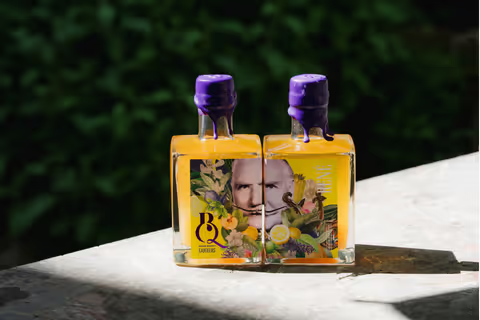
This decidedly contemporary project draws inspiration from a prominent figure in the family, Thérèse Bocquet—Victoire and Charlotte’s great-grandmother—who used to make her own liqueurs. The still-vivid memory of her demijohns, always ready to add a touch of festivity to impromptu celebrations, inspired the house’s first vintage, named after her. Naturally dubbed “Thérèse,” it is crafted with a dominant note of raspberry—her favorite fruit. Future liqueurs will bear the names of other ancestors, whose reimagined portraits—bridging the gap between yesterday and today—appear on the labels.
The cousins aren’t the only ones involved in this venture; production is based just a few minutes from Crépy-en-Valois, on the farm owned by Charlotte’s parents, who are farmers. The recipes undergo countless family tastings before final approval, each one meticulously crafted.

From Precision to Emotion
Before launching their venture, Charlotte, who came from the events industry, and Victoire, who worked in finance, trained under liqueur maker Gilles Joannet, based in Nuits-Saint-Georges in the Côte-d’Or. The two cousins have since developed a passion for the delicate art of maceration and blending, going so far as to create more than 150 different macerates before finding the desired balance. Each liqueur is thus conceived as a distinct aromatic composition in its own right. The goal is not merely to replicate the taste of a fruit but to evoke an emotion, bring back a memory, and create a rich taste experience. “Taste is what gives depth, length, and originality, ” they summarize.
This quest for flavor and quality begins with the selection of raw materials. The fruit comes from local farmers whenever possible, while certain aromatic herbs are grown in their own garden. The fruit is frozen to preserve its aromatic quality and enable year-round production. They are then carefully processed: crushed, pressed by hand, and left to macerate in beet alcohol, which is diluted to varying degrees depending on the ingredient. Both water and sugar are precisely adjusted for each batch to achieve the perfect balance. The liqueurs contain an average of 115 grams of sugar per liter—while the law requires a minimum of 100 grams—a carefully controlled level that allows the fruits and herbs to fully express their flavors. “Our goal is to associate this drink with a convivial moment. The culinary aspect is very important, ” explain Victoire and Charlotte.

A Diverse Range of Liqueurs
Launched in December 2023, “Thérèse” was quickly joined by other creations that expanded the family. Each one tells a story. “Thérèse” combines raspberry with blackcurrant, rosemary, and lime in a lively and indulgent blend. Each ingredient comes through clearly, while the rosemary provides an energetic and lingering finish. “René” showcases quince, a local fruit, paired with lime, sage, and vanilla. Conceived as a limoncello, the acidity is balanced by the quince’s natural sweetness, which lends it a honeyed quality and a beautiful aromatic complexity blending freshness, sweetness, and a delicate herbal bitterness. “Bernard,” crafted around apricot, mirabelle plum, rosemary, and almond, evokes a tart still warm from the oven. Created at the request of customers, this cuvée captivates with its rich, indulgent roundness, enhanced by a slight tension on the finish. A first limited edition has also been released. Produced in very small quantities and made from sloes harvested by Victoire and Charlotte themselves, along with juniper, lemon, and orange, “Prosper” offers remarkable aromatic intensity and exceptional length.
Overall production remains limited, at approximately 3,000 bottles per year. Each bottle is bottled, labeled, and sealed by hand by the two founders, who—in a market where liqueurs sometimes suffer from an outdated image—fully embrace the term by reinventing it. Blending family heritage, artisanal excellence, and a confident modernity, the pleasure of taste always remains at the forefront.
This article is excerpted from the Hauts-de-France guide. It is available in bookstores and on the Gault&Millau e-shop.