This Breton farm produces exceptional mozzarella
Italy doesn’t have a monopoly on the production of this cheese, which has become a favorite among the French over the past twenty years… Using milk from her buffalo raised in Brittany, Suzanna Lemoine makes an amazing mozzarella, as well as other similar products.

According to historical sources, the Asian water buffalo is believed to have been introduced to Italy between the 6th and 8th centuries. Thriving in wet environments, this sturdy animal was initially used for draft work—particularly in the rice paddies of the Far East—before our neighbors across the Alps began processing the milk from female buffalo into cheese. In central and southern Italy—particularly in the Campania region, where mozzarella di bufala is distinguished by a protected designation of origin—it comes as no surprise to see the gentle dance of these sturdy animals. This sight is far more surprising in France, where buffalo farms are rarer. And in Brittany, there are only two.
Head to the area around Vitré, in Ille-et-Vilaine, in the countryside of Erbrée, at a place called l’Aufrairie: here, Suzanna Lemoine founded her farm, Ty Bufala, in 2023—a career change for this native of Rennes, who was originally a veterinarian. “I really enjoyed treating animals, but I was fed up with dealing with people… And since I’ve always been drawn to animals and farms, I finally took the plunge! ” Driven by a desire to take a unique approach—hence her decision to focus on raising female water buffalo—she wanted to oversee every step of the process, from production to marketing.
Respect for the animals and nature
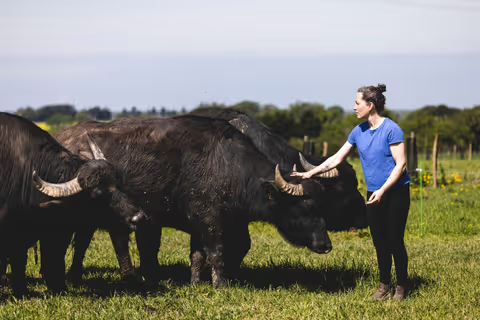
As you drive down the small road leading to her farm, you catch a glimpse of a few dark silhouettes wandering through a meadow. Suzanna takes us to meet her herd of about fifty head. With their imposing stature, dark coats, and impressive horns, these athletes may seem intimidating at first glance. But curious and sociable, the female buffalo approach to beg for a few strokes on their coarse fur. Suzie, Tajine, Tomate, Ali Baba, Brume, Tiramisu, and their friends have the peaceful air and serene demeanor of animals thriving in the open air of extensive pastures.
With about 60 hectares of land, they have plenty of room to roam and feed on lush grass, when they aren’t wallowing in the pools of water and mud—one of their favorite activities. When the buffalo have grazed a plot bare, Suzanna moves them to a neighboring pasture. In winter, she brings them indoors to the straw-bedded barn, with access to an outdoor pen, and feeds them hay produced on the farm. A 100% natural diet, animal welfare, and sustainable, balanced environmental management: these are just a few of the principles championed by the farm’s owner. Unsurprisingly, Ty Bufala Farm holds organic certification and the Haie label. Since setting up the farm, Suzanna has embraced agroforestry by planting more than 2,000 trees—including chestnut, serviceberry, pecan, and many other species. In addition to carbon sequestration, the trees offer invaluable benefits: they enhance biodiversity, act as windbreaks, and provide shade for the animals when heat waves strike Brittany.
Exceptional Milk
The former veterinarian isn’t the only one working… Every morning, around 5:30 or 6:00 a.m., the female buffalo give their milk. “They’re very affectionate, but they won’t do what they don’t want to do,” Suzanna warns. “You have to know each one’s temperament and know how to motivate them for milking—with a little grain, for example.” Far from being walking milk machines, the female buffalo produce only four to six liters of milk per day, compared to twenty to thirty for a cow, depending on the breed. That’s not much, but the milk is exceptional—rich in trace elements and minerals, and much higher in fat and protein than cow’s milk, resulting in a much higher cheese yield. Suzanna processes the raw milk from her herd two to three times a week. We weren’t lying: farmhouse mozzarella is indeed made in Brittany—a world apart from the industrial “mozzas” that flood the shelves of big-box stores.
Stretched-curd cheeses—a family all their own!
The owner of Ty Bufala learned the craft from an Italian producer near Carcassonne. Like provolone or burrata, mozzarella belongs to the family of stretched-curd cheeses, which are made by stretching the curd while it’s still hot. To do this, Suzanna heats the milk to 37°C, adds a starter culture and rennet to allow the curd to form. She cuts the curd a first time and then waits a few hours. When she determines the curd is ready—after a stretch test—she drains off the whey, which will delight the quirky Mangalica pigs with their astonishingly woolly coats.
Once thoroughly drained, the curd is transferred to another vat. She kneads it by hand, then pours boiling water over the curd. Using chopsticks or spatulas, Suzanna then begins the stretching process. This involves stretching the curd to create a smooth, uniform paste with a certain sheen. This dough is then divided into pieces and shaped into balls, which are immediately submerged in cold water to set their shape. An hour later, the mozzarella balls are packaged in jars with brine.
Suzanna explains that Italians like their mozzarella on the firmer side, whereas the French prefer it softer. In this regard, she shares the Italian preference. But don’t worry—her “mozza” is by no means like a block of concrete: it’s actually tender and delicious! And the closer it gets to its best-by date, the softer it becomes.
To preserve its flavor, Suzanna suggests enjoying it fresh—cut into cubes as an appetizer with a drizzle of olive oil—or in a salad of lamb’s lettuce, cooked beets, and toasted almonds. Alternatively, she sometimes adds a few pieces to pasta at the last minute. While mozzarella is her flagship product, Suzanna also makes smoked scamorza, a somewhat similar cheese. The production process is identical—or nearly so... After their brief soak in cold water, the balls aren’t packaged right away, as with mozzarella, but are drained instead. They continue to dry in a cold room for about twenty days. Then, they spend about twenty-four hours in a homemade wooden smokehouse where, little by little, the subtle aromas of beechwood smoke permeate the pale yellow curd, which is firmer than that of mozzarella.
Tome, Yogurt, and Rice Pudding
What makes a mozzarella worthy of the name? First and foremost, the livestock! On farms that practice intensive agriculture, female buffalo are confined to barns and fed corn silage. Not the best way to produce milk—and subsequently, flavorful products… Suzanna also mentions the selection of a good starter culture, the farmer’s ability to adapt to weather conditions and the characteristics of the milk—which can vary depending on the season or stage of lactation—and, of course, mastery of the stretching technique.
Let’s be clear: this young woman didn’t become a farmer to succumb to some form of standardization! And at the Vitré market, in farmers’ markets, at fine grocery stores, and with local restaurants—notably the excellent Petite Ourse in downtown Rennes—Ty Bufala’s products are enjoying well-deserved success. Without a moment’s hesitation, we’ve joined the ranks of aficionados for the mozzarella, the scamorza, but also the tome cheese, the yogurts, and the rice pudding… All that’s left is to try the meat, which Suzanna sells occasionally when she parts with a male cow.