






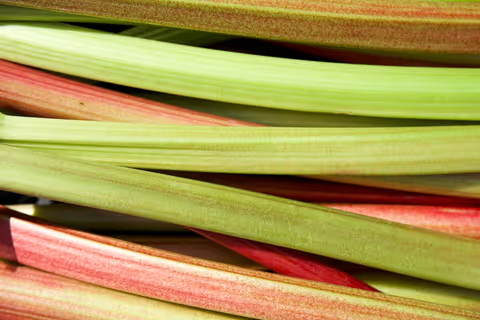
This producer from Picardy grows more than 100 varieties of rhubarb
Whether green or red, tart or sweet, early or late-season, these rhubarb varieties are called Grand Mums, Mikkot, Early Victoria, Goliath, Mira, Frambozen Rood, Seedling, Elmblitz, or Valentine. In Saint-Riquier, in the Somme department, they are grown by a father-son duo who have become the leading experts on this vegetable—which is classified as a fruit.

Saint-Riquier, population 1,300, a 13th-century abbey church, a military cemetery, a “Napoleon” house listed on the inventory of historic monuments, a belfry designated a UNESCO World Heritage Site, crops stretching as far as the eye can see (beets, potatoes, grains), large-scale dairy farms—and in the midst of it all, Mathieu Vermès, a rare rhubarb grower.
Mathieu, the Enthusiast
The son of a farmer, with a high school diploma in agriculture and an advanced vocational diploma in floral production, Mathieu completed various internships in France and one in Australia, which ultimately convinced him that he was cut out for the nursery business. Upon returning to Saint-Riquier, he began working part-time on the family farm with his brother on the dairy side, while dedicating the other half of his time to establishing his own shrub nursery. It was the mid-1990s, and local agricultural authorities were encouraging dairy farmers to diversify their income by planting rhubarb—a crop that was easy to grow, high-yielding, and low-maintenance. Mathieu embarked on this venture with about fifteen other farmers. Very quickly, most of them stopped production when they realized that none of the work could be mechanized. Mathieu persisted and expanded. He expanded from 2,000 square meters to 2 hectares, from four varieties to about ten, and developed a passion for this vegetable native to Asia, which Marco Polo is said to have brought back to Europe. It was long used for its medicinal properties before being consumed as food starting in the 18th century.
Over time, as his knowledge grew, Mathieu became a collector, seeking out and exchanging plants with fellow enthusiasts in England, the Netherlands, and Germany. Today, he owns more than a hundred varieties (1,500 plants for some, 50 for others, and just 2 or 3 for the rarest ones), whose names are not always verified, as some are merely ornamental and not edible.

Mathieu, the Meticulous One
At the helm of his farm—and while his children are pursuing their studies—Mathieu produces, depending on the year, between 25 and 35 metric tons of stalks sold exclusively to the cooperative, which buys them from him at one euro per kilogram, from which he must deduct the cost of the delivery crates, which he is responsible for. Considering the time invested, it’s hardly a lucrative venture, but Mathieu pays himself a salary nonetheless. There is one person who realizes that not everything is running smoothly in the land of rhubarb. Valentin, one of his three sons and a graduate with a BTS in communications, sees himself as a sports journalist. Lacking the right connections, he realizes his dream won’t come true. He suggests to his father that he join him and help him revamp his distribution model. Glad he hadn’t skipped his classes on SEO and social media, Valentin opened an Instagram account in late 2017 and a Facebook page. He fine-tuned the photos, crafted compelling content, and showcased his father’s daily life. He suggested that his father stop relying solely on the cooperative and instead reach out to chefs, pastry chefs, and jam makers.
At first, Valentin sent emails to professionals. No one replied. He knew that their revenue wasn’t enough to cover two salaries. So he needed to get the chefs interested. A pastry chef, Claire Damon, mentions their name on a TV show. Word of mouth picks up speed, and the first orders are shipped. In three years, Valentin reverses the distribution trend and increases the farm’s revenue. Production kept pace: 37 metric tons in 2020—3 of which were delivered to the cooperative—and 65 metric tons in 2024, now harvested from 4.5 hectares spread across two plots located in Saint-Riquier and Liancourt.

Rhubarb Almost All Year Round
For consumers, rhubarb is synonymous with spring. It appears on market stalls in April and remains a seasonal product. This is not entirely true, however, as there is not just one but several varieties of rhubarb, and they do not all grow during the same season. In the Somme region, the season begins in late March, depending on weather conditions, and ends around mid-October with the last stalks of the Mira or Valentine varieties—and sometimes even Livingstone around Christmas. We need to educate industry professionals to explain that the season spans seven months. The rest of the time, we have to tend to the soil. In January, father and son enrich the clay soils with chicken manure and then mulch to protect the crops from frost. This is also the time when Mathieu removes dozens of plants that have given their all over the past six or seven seasons. However, they aren’t dead—a rhubarb plant can live for more than 50 years. Each plant is divided into ten smaller plants, which are replanted to grow into new rhubarb plants that will yield their first stalks the following year.
When the season begins, every morning, Valentin reviews the orders received the previous day via text message, phone, and social media, and heads out to the fields to give his harvesting instructions. The act of picking is simple but hard on the back. You work your way down the stalk, twist the base, and pull gently without tearing it out—this allows the stalk to regrow for a second harvest and possibly a third during the season. A swing of the machete clears away the foliage deliberately left on the ground to serve as mulch, and the stalks are sorted by size (some, like the Goliath variety, can weigh up to one kilo) and packaged for delivery the next day throughout France. It’s grueling work, but the duo takes pride in knowing that the fruit of their passion is handled by the industry’s leading names.
This article is excerpted from the Hauts-de-France guide. It is available in bookstores and on the Gault&Millau e-shop.