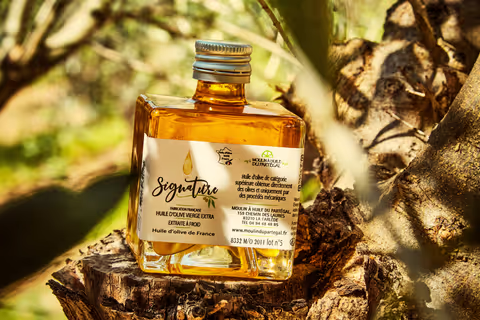
Choosing the Right Olive Oil
Good olive oil is enjoyed just like good wine: each variety, each blend, and each harvest reveals a different flavor profile. But you still need to know which one to choose from the shelves at specialty food stores and supermarkets.
A good olive oil is savored just like a good wine: each variety, each blend, and each harvest reveals a different flavor profile. But you still need to know which one to choose and how to sort through the shelves at specialty food stores and supermarkets, where it’s sometimes all too easy to fall for the marketing hype surrounding the Mediterranean diet.
The designations
These are strictly regulated by the International Olive Council (IOC). Extra virgin olive oil is a guarantee of superior-quality olive oil, extracted using mechanical processes (without solvents or refining) from the first cold press. In short, it is pure fruit juice, where the acidity level must not exceed 0.8% under any circumstances. Virgin olive oil is extra virgin olive oil with slight organoleptic defects that result in its being downgraded. The defects in lampante olive oil are such that it is unfit for consumption: it must be refined and blended with virgin olive oil before it can be consumed. On supermarket shelves, consumers should be wary, as cheaper olive-canola blends are sometimes found mixed in with olive oils, causing some confusion.
Producer/marketer
If the label says“producer,” it means the oil comes from the olive grower’s own olives and not from a marketer who simply blends oils—such as Puget, Tramier, Terra Delyssa , orprivate-label brands. The difference? A producerseeks a distinctive character—the result of a delicate balance between nature and human craftsmanship— whereas marketers aim for a consistent taste from one year to the nextso as not to confuse the consumer. That doesn’t mean they’re any less good. “Some retailers, thanks to rigorous selection, offer oils that can rival those from certain mills, ” explains olive oil expert Alexis Muñoz. In 2025,Primadonna extra virgin olive oil,sold at Lidl, topped a ranking by 60 Millions de consommateurs.
Varieties
Picholine, Arbequina, Frantoio, Kalamata… Thereare reportedlybetween 1,500 and 2,000 olivevarieties worldwide, but about twentyof them dominate the global market.Each has a unique flavor and aroma profile. “Variety plays a decisive role in the aromatic profile, often even more so than the terroir— unlike what we see with wine, ” notes Alexis Muñoz.
Ripeness
The timing of the olive harvest affects the aromatic profile of the olive oil. Depending on the stage of ripeness, the oil will have a green, ripe, or black fruitiness.
Origin
There are several dozenprotected designations of origin (PDOs) in the European Union, including nine in France (Nyons, Vallée des Baux-de-Provence, Aix-en-Provence, Haute-Provence, Nice, Nîmes, Corsica – Corsica Oliu di Corsica, Provence, and Languedoc) that guarantee the olives are pressed in a mill located within the designation’s geographical area. On the other hand, olive oils with Protected Geographical Indication (PGI) status (Tuscany, Sicily, Calabria, etc.) areless common . Otherwise, it’s best to keep your eyes open so you don’t get fooled.For example, the organic extra virgin olive oil “Le moulin de mon père” (marketed by Émile Noël), which can be found on certain websites and at open-air markets, is sourced from both the EU and non-EU countries. It is likely a blendofSpanish andTunisian oliveoils. The company also has no qualms about selling other organic olive oils of both EU and non-EUorigin, whose labels feature a tricolor flag. And what about Carapelli, with its distinctly Italian-sounding name? Not only is the brand—founded in Florence in 1893— now ownedby the Spanish olive oil giant Deoleo, but its olive oils sold in supermarkets are all of both EU andnon-EU origin. Just like the Provençal brand Tramier, whichwas alsoacquired by a Spanish group, Borges, in 2007. Puget, which is seeking to reaffirm its brand’s iconic status this year through an advertising campaign, has no qualms about capitalizing on its Provençal roots (the brand was founded inMarseille’s Old Port in 1857). And so what if its olive oil comesexclusively from Spain?
Packaging
One of the golden rules for preserving the quality ofolive oil— which is prone to oxidation— is to store itin a dry, dark place away from light. When it comes to packaging, metal cansoffer the best protection. Next best are dark-tinted glass bottles. Finally, it’s best to avoid clear glass bottles , as well as plasticones , which may release chemical compounds over time.
Best-by Date
Unlike wine, olive oil does not improve with age. On the contrary, it oxidizes and loses its flavor and physicochemical qualities. “It’s advisable to store good olive oil for no more than a year—both for the taste and to fully enjoy its health benefits,”recommends Christophe Lavelle, a biophysicist and research fellow at the CNRS. This is especially true since the best-by date is not calculated based on the harvest year, as the magazine *Que choisir*explains , but rather on the year of bottling. “However, many mass-market products blend oils from different vintages: so you might find an oil made up of 15% from 2021, 30% from 2022, and the rest from 2023, with an expiration date based on the bottling date! , ”warnsthe magazine.
Its Use
Olive oil’s status has changed. In the past, in certain regions, the all-purpose bottle held pride of place in our kitchens. However, sincecooking destroys much of olive oil’s aroma, it’s not essential to have an exceptional product on hand. On the other hand,as a dressing, itremains indispensable, as it brings outa wide range of flavors
This article is excerpted from Gault&Millau magazine No. 14. It is available in bookstores and on the Gault&Millau e-shop.