In Savennières, Éric Morgat crafts Chenin Blanc outside of current trends
Since 1995, Éric Morgat has been exploring the potential of Chenin on the schist-covered slopes of Savennières. Between preserving grape varieties, sacrificing yields, and navigating climate challenges, the winemaker pursues a patient endeavor, marked by experimentation, humility, and a long-term perspective.
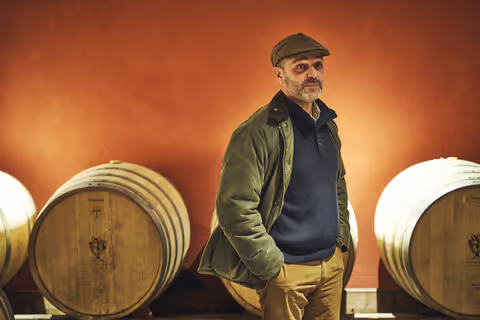
On the way back, as we retraced the thread of a conversation as rich as it was disjointed, we asked ourselves: at what point had we left our hectic era behind to slip into this timeless, calm, and soothing atmosphere? Was it as we crossed the metal bridge spanning the full, sleepy Loire River, heading toward that village frozen in time called Savennières (Maine-et-Loire)? Was it along the winding cobblestone paths, flanked by stone walls, that lead straight to that tiny 5th-century church? Perhaps while passing through the door of À table chez Mili, with its square terracotta tiles on the floor—a restaurant with a single-course menu, offering simple cuisine untouched by Instagram-worthy trends? Or, more likely still, upon entering the estate of Éric Morgat, a skeptical winemaker in a hunting jacket with a defiant look on his face?
Schist and sand
Coming from a family of winemakers in the Coteaux-du-Layon appellation “for many, many generations, ”Éric Morgat struggles, at first glance, to talk about himself. As if he feared being pigeonholed into a narrative, a trend, or a fad—the very things he’s spent his whole life fleeing...Originally, he wanted to “belong somewhere,” to relearn “the ways of the past,” and to break away from the chemicals and practices that had led Anjou wines—already subject to the vagaries of the climate—astray. To find his own path, he left the family home and moved elsewhere—but not too far away. Across the Loire, in the town of Savennières, where plots of land—preserved from chemicals but abandoned by wealthy local families—were for sale. Fallow land where everything needed to be rebuilt from scratch. He settled there in 1995 and gradually expanded his estate to 6 hectares. He was 25 years old: “From the very beginning,” the winemaker recalls, “the goal was to make great white wines, ” at the heart of an appellation known for its dry, semi-dry, and sweet whites that enjoys a good reputation. Cultivated on barely 200 hectares, the vineyards here benefit from a favorable semi-oceanic climate. Famous neighbors, such as La Coulée-de-Serrant, have been producing wine here for nearly 1,000 years. The soil in Savennières is nothing like the limestone-rich Anjou across the way. Schist is everywhere, often covered by a thick layer of sand. It’s soil that doesn’t retain water, and rainfall is moderate—600 to 700 millimeters per year. “In Savennières, the vines have roots in Roussillon and leaves in Brittany,” explains Éric Morgat.
Experimenting Takes Time
In this monastic landscape where the Loire flows silently, the winemaker seeks to stand out and understand this “wild and rebellious” Chenin, which buds very early and ripens late. A chameleon-like grape variety, ideal for revealing the “local signature”—that “airy tannic structure” of Savennières wines. On abandoned hillsides and steep slopes, he replants and convinces the INAO to reclassify his plots within the appellation. In his vineyards, natural grass cover is complete from the start, out of respect for a soil he has seen over-tilled elsewhere and thus deprived of its organic matter. “I like to apply what I’ve learned elsewhere, and I’ve attended conferences for dairy farmers in Brittany,” he explains. “Depending on how they manage their pastures, the health and quality of their cows’ milk vary. In pastures, if you mow too often, the soil doesn’t thrive.”
Drawing inspiration from livestock farming, Éric Morgat intervenes as little as possible on his soils, simply supplementing the plant cover by sparingly sowing legumes. “Agronomy is a complex subject,” he says, “and agronomists like Messrs. Bourguignon and Bouchet, whose work I’ve read and whom I’ve met, don’t agree on everything. In fact, it’s a vast field about which we know very little. I don’t belong to any particular school of thought, but I experiment—it takes time. I realized very early on: when it comes to soil, the less you do, the less likely you are to make a mistake. Ideally, you’d leave the soil untouched. But since we’re growing grapes, we can’t avoid working the soil. I let nature manage the weed growth, and I try to control it through light subsoiling. I roll the straw and try to lightly scratch the surface to prevent water stress and ensure that an overly dense root system doesn’t compete with the vines.”
The Aesthetics of the Wines
To find the right balance, Éric keeps an eye on everything. In the vineyard, where his colleagues Nicolas and Louis-Marie are pruning that day according to the principles of François Dal, who teaches in Sancerre; and in the cellar, where, after spending a year in barrels, each vintage is divided into two parts: one part goes into stoneware amphorae to gain roundness; the other into stainless steel tanks, where the wines develop length on the palate. The winemaker then blends them, following a process he applies to each of his three cuvées: Fides, Clos Sertaux, and Litus.
How would he define his approach? Does he identify with “natural” wines? Does he practice biodynamics? The debate is quickly settled: the winemaker has tried all of these methods and has since moved on from them. While he strives to respect living organisms and is certified organic, Éric wants to do things his own way: “When I hear people talk about so-called natural wine,” he says, “I hear them talking about technique, not wine. What interests me is the aesthetic.” Even if it costs him, his wines are therefore lightly sulfured when he deems it necessary. Similarly, the “terroir” trend leaves him cold. He prefers to blend grapes from different plots on his estate to create a unique wine. Gone is botrytis, that little fungus elevated to local fame, which appears on the grapes and gives local wines that more or less syrupy character. A decade after settling here, Éric now harvests earlier, before the fungus appears on the grapes. He aims for simplicity, “transparency,” refinement, and lightness. His 2020 Fides vintage is undoubtedly the most striking example of this aesthetic pursuit. An extraordinary nose, with hints of pear. And a delightful “mouthfeel”—the winemaker’s primary concern. “A bit too intellectual of a wine, isn’t it?” he says with a wry grin that could be mistaken for a smile. No, it’s simply the elegance of 25 years of unique craftsmanship, which places it among the greatest white wines. To achieve this, the winemaker has sacrificed yield, which ranges from 20 to 25 hectoliters per hectare, resulting in fifteen to twenty thousand bottles per year across all vintages.
The Winemaker’s Destiny
While he refuses to yield to trends, Éric has mellowed somewhat with age. The 2022 vintage is rounder, a bit fruitier. It may be enjoyed sooner, whereas his wines typically reach their full potential after about fifteen years of aging. Will he continue down this path? “The longer I’m in this business, the more questions I have and the fewer certainties I have,” he confesses humbly. “Especially since the climate is changing, too.” Climate change? Éric first mutters under his breath that he’s not afraid of it, that he knows he could lose everything in a particularly violent storm, and that such is the fate of a winemaker. “Thirty vintages—it takes its toll a bit,” he adds soberly. “I’m less sure of my ability to adapt.” Then he points out, nonetheless, that his generation is fortunate: “In the 1970s, the Chablis vineyards froze every year. The winemakers were forced to set up oil-fired heaters in the vineyards; otherwise, they wouldn’t have been able to make any wine.” And as if to ward off the threat of the future, the winemaker once again draws on the past—that of his family, which weathered every calamity, vine diseases, and world wars without ever being uprooted. But the threat is still there: “Take the example of the most recent vintages,” suggests Éric. “2021? Frost. 2022? Temperatures topped 38 degrees in June. 2023? It’s hot. And 2024 is worse than 2021. How do we adapt to that? I have no idea. Nature reminds us of our insignificance. Farmers, fishermen… we’re on the front lines.”
A Passion for Painting
Yet he’s carefully preparing for the future. From the tasting table above the wine cellar, a window offers a glimpse of a Chenin conservatory, planted in 2010. Thirty-seven varieties vinified separately. This effort at genetic diversification could prove invaluable in the face of climate disruption. “When you taste this 70-are plot, it’s like fireworks,” he explains. “Some grapes are overripe, others aren’t ripe enough. It’s all over the place—there’s great aromatic intensity, but also a lot of waste. Over the past five years, only three varieties have yielded well. But that doesn’t mean others won’t perform better in the future. ” And as a final twist, Éric Morgat concludes the discussion by invoking his passion for painting through the work of his friend Marcel Hasquin, an artist with whom he collaborates on his labels, and quotes the great William Turner, who traveled up the Loire and painted it in 1826. A painter whose talent fascinates him, “who searches, who paints little by little. Why couldn’t the winemaker, too, spend his whole life searching?”