






48 Hours on the Flax Trail in the Pays de Caux
Normandy/2026
The Pays de Caux, a region dear to Maupassant, is an inexhaustible source of scenic walks. Its chalk cliffs, winding valleys, meadows, and apple orchards, along with its long history, have shaped a distinctive landscape, enriched over the centuries by flax production.
Normandy is now the world’s leading flax-producing region, accounting for 63% of national production and more than 50% of global long-fiber production. In the foreground lies the Pays de Caux, stretching from the outskirts of Rouen to the sea, where spring blooms in shades of blue all along the route. As far as the eye can see, winding around the bends of the Seine and stretching all the way to the Dieppe region, the flax fields—thanks to favorable soil and climate—yield this magical plant, which is used in both the textile industry and the food industry, particularly for flour.
This “Flax Trail” also offers the chance to discover historic and architectural sites. Simply follow the Seine and let yourself be guided: the first stop is Jumièges, whose magnificent abbey was described by Mérimée as “the most beautiful ruins in France.” Beyond the ruins — arches and vaults —it is the serene atmosphere and the quality of the light that are most strikinghere . Around Jumièges, along the riverbanktoward Le Mesnil-sous-Jumièges, orchards supply regional markets with apples, pears, and berries depending on the season. Saint-WandrilleAbbey, now part of the new municipality of Rives-en-Seine, isalso breathtakingfor itsbeauty, its surroundings (if you can, take the beautiful road from Bouville, through the plains and woods), and, as an added bonus, the magnificent Gregorian chants that the monks sing during morning Mass and at 5:30 p.m. Vespers.
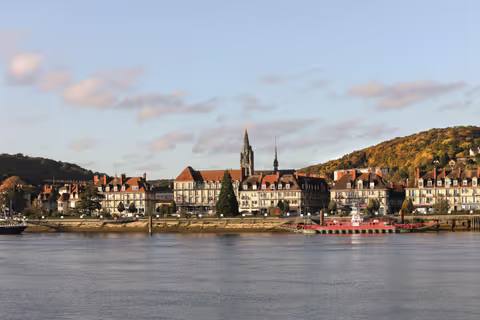
From there, the route naturally leads to Caudebec-en-Caux, passing under the slender Brotonne Bridge, a cable-stayed structure inaugurated in 1977 that spans the Seine. This beautiful,traditional village was a major culinary destination in the days of Maurice Lalonde and the famous, two-century-old Hôtel de la Marine, where all the great Norman chefs once stayed.Downstream, Villequier, nestled in a bend of the Seine, commemorates the tragic drowning of Léopoldine Hugo —Victor’s eldest daughter—and her husband Charles Vacquerie in 1843, a memory the famous author honored in numerous poems, including *Demain, dès l’aube*…
We thenhead to Yvetot, a large market town that is now considered the capital of the Pays de Caux. Legend has it that there was once a kingdomhere , popularized by a19th -centurysongby Béranger,*LeRoi d’Yvetot*. The town was burned and nearly destroyed during World War II, hence its modern architecture , square layout, and wide streets inthe city center, dominated by the impressive Saint-Pierre Church—a contemporary circular structuredesigned by Max Ingrand, featuring a glass roof spanning over 1,000m²and a44-meter-high bell tower. We concludewith Doudeville, nicknamed the “linen capital” for its historic linen industry dating back to the18th century. The Linen Festival takes place there every year in June.