






48 hours in Compiègne
Hauts-de-France/2026
A historic city that is very much in step with the times, a lively subprefecture with a pleasant and vibrant downtown. Quality of life, a beautiful environment, and a large green space right next to the city: the people of Compiègne have everything they need to be happy and to share that happiness with visitors.
Schoolchildren hear its name mentioned several times throughoutFrenchhistory . Charles V built the first castle there at the end of the14th century, while Joan of Arc was captured in 1430 very close to Compiègne by the Burgundians and handed over to the Bishop of Beauvais, Pierre Cauchon, an ally of the English. We know what happened next… Louis XV had the castle rebuilt in its current form by the architect Ange-Jacques Gabriel. His grandson, Louis XVI, would spend very little time there… NapoleonI turned it into an imperial residence, which he had remodeled beforewelcoming his second wife, Marie-Louise of Austria,there for their first wedding night. The Second Empire proved inseparable from Compiègne, as NapoleonIII was particularly fond of the château. There, together with Empress Eugénie , heorganizedthe famous “séries,” gatherings of about a hundred guests —sovereigns, diplomats, artists, scientists, and others — for four to six weeks during which the constraints of etiquette were set aside.
In modern times, the magnificent Compiègne Forest was the site chosen by Marshal Foch to sign the armistice of November 11, 1918, in the now-famousRethondes railway car. In 1940, Hitler demanded that the new armistice, favorable to him, be signed in the same railcar, which was subsequently transferred to Berlin and set on fire before the Allies arrived in 1945. Today, at the Armistice Memorial—ten minutes from downtown and in the heart of the forest—visitors can see a replica of this train car, which is in fact an identical twin of the original, furnished exactly the same way and produced as part of the same series.
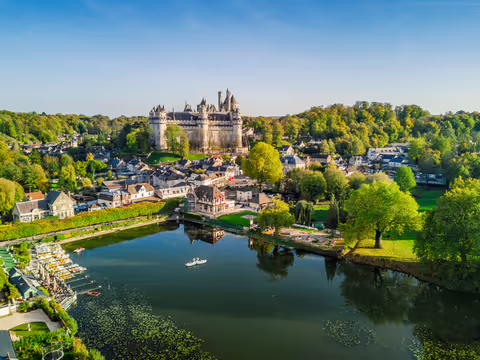
In addition to the castle with its beautiful collections,including sumptuous sleighs and carriages from centuries past, visitors can also admireCity Hall , built in the early16th century in the Flamboyant Gothic style, as well as the churches of Saint-Jacques and Saint-Antoine— all three of which are designatedhistoricmonuments . A walk through the Compiègne Forest can be followedby a visit to the stunning Château de Pierrefonds, set in afairytale-like setting. Built on the site of a 14th-century fortified castle, complete with towers, keep, and machicolations, it was entirely redesigned in the Neo-Gothic styleby the brilliantViollet-le-Duc, the architect andrestorer of Notre-Dame de Paris, at the request of Napoleon III.
The bustling heart of the city is very pleasant, partly pedestrianized , and teeming with commercial activity. There are many artisan food vendors here, andone of the best streets for such delights, Rue Saint-Corneille, hosts a large market along its entire length on Wednesdays and Saturdays. Right near City Hall, Rue des Pâtissiers is as charming as it is indulgent. The residents of Compiègne enjoy Picardy specialties found in a few regional restaurants (caqhuse, ficelle…) and the local“Picantins,” roasted hazelnuts coated in chocolate, reminiscent of the eponymous figures carved on the belfry’s clock.