48 Hours in Verdun
Great East/2026
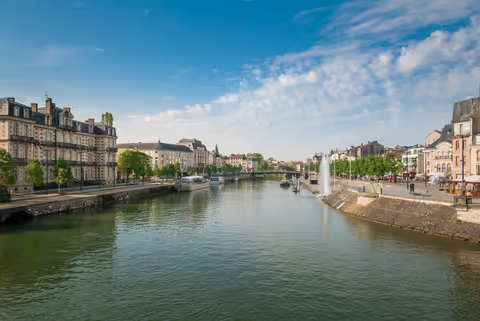
The city is bustling; children are playing, and you can hear laughter and shouts. The Meuse River is quite pretty, and you can stroll along its riverbanks, lined with terraces, bars, and small restaurants. While Verdun is steeped in history, it has plenty of other attractions that make it worth a visit.
This subprefecture of 17,000 residents features in historybooks in more ways than one. And for good reason: Verdun gave its name to the treaty that, in 843, divided Charlemagne’s empire among his three grandsons— an event marking the end of Carolingian unity and the beginning of the kingdoms of France and Germany.Later, in 1648,theTreaties of Westphalia formalized the incorporation of the Three Bishoprics (Metz, Toul, and Verdun)— which had previously been part of the Holy RomanEmpire— into the Kingdom of France . And then there is Verdun: for the grandparents of the oldest residents and the great-great-grandparents of today’s generations, it was the site of the greatest battle of World War I, in 1916.
A century and ten years have passed. Generations have come and gone, memories have faded, and family stories have becomerarer. Verdun is part of French history, just like Wagram or Marignan. Only the power of collective memory, monuments ,and commemorations—whether physical or in the media—conveys the scale of what were among the most horrific battles in history. 700,000 casualties in ten months, more than 300,000 dead, roughly equally divided between the two sides.
While it is difficult to imagine the relentless barrage of shells that rained down on these now-peaceful plains surrounding the city, the monuments speak for the dead. Whether you’re a pacifist, an activist, a soldier, a political advocate, a casual tourist, or simply a human being, a visit to Douaumont, north of the city, cannot fail to be a profound experience. The chill and dread that grip you in the immense , dark crypt with its 16 ,000 graves—knowing that the Ossuary site holds the remains of some 130,000 victims— are sensations you will never forget. To add to the emotional impact, there is also the Verdun Memorial in Fleury-devant-Douaumont and the Verdun Underground Citadel at the entrance to the city, whose tunnels sheltered thousands of soldiers, a hospital, and the command post.
In 2026, Verdun has other attractions worth exploring. The Verdun dragée, a coated almond, is a specialty dating back to the13th century, and let’s not forget that the city historically belongs to Lorraine, a region renowned for its cuisine, where they make quiche, cookies, madeleines, tourte, and Lorraine pâté. The mirabelle plum trees yield a highly renowned brandy, and starting at the end of summer, Verdun’s pastry shops treat visitors to mirabelle plum tarts. Local products can also be found in the covered market halls every Friday, where the city’s main market is held .
From fall through midwinter, people seek out the prized Meuse truffle, which adds its aroma to terrines, poultry, and game, and pair it with Meusewine from theCôtes-de-Meuse IGP,whose vineyards stretch along the valley. A visit to a few wineries will also allow you to explore the beautiful surrounding countryside as you enter the Lorraine Regional Nature Park, notably to the lovely site of Lake Madine, about 40 kilometers southeast of Verdun.