






The secrets of rum-making
Rum is not a perfume in a bottle, nor a simple accent of vanilla on a smile of crushed ice. It's first and foremost a distillate, an eau-de-vie born of sugar cane, bearing the memory of a field and the imprint of a technical gesture. Let's light up our lanterns and shed some light on the step-by-step process.
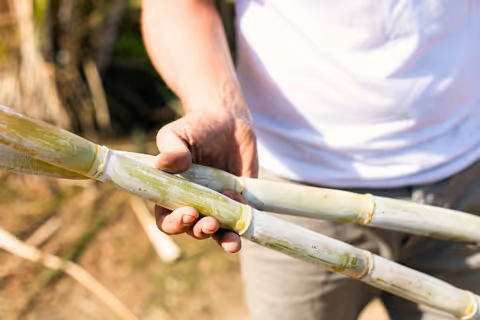
Rum comes from a plant native to Southeast Asia and Oceania, sugar cane, which today comes in some 4,000 varieties from six ancestral strains. But contrary to popular belief, there's more to this spirit than its unique aromatic profile. Its personality is forged from the very first link in the chain: the choice of raw material.
A cane with juice
Pure cane juice, the true grail of purists, represents only 2% of world production. This approach, a French tradition par excellence, is only just beginning to be exported and to inspire distilleries elsewhere in the world. It produces a floral, fruity, juicy liquid that retains the plant fiber and gives the impression of biting into the cane. Some countries prefer to heat this juice to transform it into cane honey, a thick syrup that travels better. It retains the signature of the cane while developing, through the Maillard reaction, accents of honey and caramel. Houses like Colombia's Dictador have embraced it, embracing this patisserie approach that's not lacking in character.

Molasses, a successful waste product
Most sugar cane is used by the sugar industry. First, the sugar that can be crystallized is extracted, which becomes the famous cane sugar, used in pastries or as a dip in our coffee. Next came what would become the basis of countless rums: molasses, a dark residue long considered a waste product. It is diluted, awakened with yeast, and the alcohol is produced during fermentation before being presented for distillation. when tasted, the boundary between cane honey and molasses narrows, but the more thorough cooking of the latter often imparts notes of baked caramel and licorice.
Fermentations, the art of letting yeast do the talking
Fermenting means letting the yeast transform the sugar cane into alcohol, but also into aromas. Time is everything. Some producers in Jamaica, Guyana and Trinidad have elevated fermentation to an art form. Where Martinique (and many others) limit their fermentations to 120 hours, these masters of"high ester" allow their musts to evolve for weeks on end. Once the sugars have been depleted, another fermentation takes over, creating esters and developing aromas of exotic fruits, hydrocarbons and even those distinctive notes of chalkboard felt. Hampden, in Jamaica, is a perfect example of this cutting-edge approach, which appeals to connoisseurs in search of new sensory experiences.
The art of distillation: three schools, three philosophies
The rum's personality is then sculpted in the still. Three traditions coexist, each bearing the imprint of its colonial heritage. The Creole alembic, a little cousin of the one used in Armagnac, perpetuates the French tradition. It's a kind of column that enables continuous distillation (as long as it's filled, it distills), with perforated plates to adjust the aromatics passing through.
The pot still, borrowed from the world of whisky and cognac, reigns supreme in Jamaica, Barbados and Trinidad, faithful to its British heritage. It often uses the principle of double distillation, resulting in incomparable texture and density. Each pot still is considered to have a unique shape, resulting in unique aromas.

Finally, the large distillation columns favored in Cuba and Puerto Rico reflect the Hispanic approach of maximizing yields while lightening the aromatics. This produces rums of crystalline purity, blank canvases on which aging can paint its nuances. Hispanic rums rely on time and wood to reveal their complexity.
Aging without dogma
Rum enjoys a rare freedom: it can bear its name whether it's white or aged, whereas a whisky has to spend a minimum of three years maturing in cask to obtain this name. The oak cask, generally ex-bourbon (whisky made mainly from corn in the USA) because of its geographical proximity, brings notes of vanilla, coconut and woody complexity. But it also loses that precious freshness and vegetal purity. Time doesn't guarantee quality, it just establishes a preference. Some will want the purity of fruit, others, the language of the barrel, ample and generous. Climate also plays its part. Tropical aging, on the islands, accelerates and intensifies extraction. Continental aging, in temperate zones, favors gentleness and patience.
A world without regulatory borders
Outside strict French appellations such as AOP Martinique, the rules are remarkably flexible. In Europe, it's a cane spirit, with the possibility of adding a little sugar and coloring agents within set limits. Jamaica, on the other hand, allows cane juice, honey or molasses as raw materials. The color of the word varies without dogma: like whisky and whiskey, rum and ron are more a matter of linguistic usage than guaranteed aroma.
This permissiveness has also encouraged the emergence of"rum-based spirits" such as Don Papa, with high sugar levels, as distinct from pure rum. to these we can add arrangés (macerated fruit in rum with added sugar) and spices (or spiced, macerated with spices). Paradoxically, these products have helped democratize the category in France, attracting new enthusiasts.
To taste is to choose
From Brazilian cachaça, a cousin of rhum agricole, to the arrangés of La Réunion and the spiced rums of the Caribbean, each region has developed its own interpretation of this cane brandy. This richness makes rum an inexhaustible territory of exploration, where each bottle tells a unique story, that of a terroir, a know-how and a vision.
This article is taken from Gault&Millau magazine nᵒ 12. It is available on the Gault&Millaue-shop.