






This forgotten Beaujolais cru could well become a world model
Total grassing, 240 trees planted per hectare in the heart of the vines, pulling out vines to make room for them... At Château de Javernand in the Chiroubles appellation, Pierre Prost and Arthur Fourneau are rethinking everything to revive their soil and produce fresh, silky wines.
A highly prized cru at the turn of the 1990s, it has gradually fallen into disuse. Situated less than five kilometers from the famous village of Villié-Morgon [Rhône], the Chiroubles appellation has fallen asleep.has fallen asleep, unable to resist the age of "glouglou" wines and star-studded winemakers on Instagram. From the Mâcon-Loché train station, however, one is struck by the beauty of this undulating terroir and then, at the bend in a valley, at the end of an avenue of lime trees, by this pink winegrower's house, dominated by a centuries-old walnut tree. Here, at Château de Javernand, a hint of Italy can be found in the landscape as well as in the glass, when the Indigène cuvée is as much a taste of Friuli as it is of Beaujolais. How, in the midst of chemically-scorched hillsides, granite and hectares of Gamay Noir, do we find such freshness and aromatic richness?

Warming up too much
Until then, the family estate had lived its life without stepping out of line. Since 1917, to be precise, and through five generations, the road seemed all mapped out. And then, in 2017, a complete change of course, a real leap into the void: Pierre Prost and Arthur Fourneau, aged 44 and 45, who run the estate together after studying engineering, wanted to do less, but better. To achieve this, they have cut back from 12 hectares to 8. Why this radical change of direction?because we became fathers," explains Pierre Prost, "and we began to wonder what we were leaving behind. Erosion, soil impoverishment and climate change are all here, and the fight for living things seemed to us to be a priority for the future."So far, it has smoothed out the years and brought a certain regularity to the Beaujolais crus, but global warming is now "too much", says the winemaker. Some years, it doesn't rain from mid-May to the end of August. How do you retain water on hillsides damaged by decades of vineyard work? In 2017, Pierre and Arthur are betting everything on agroforestry. Not the cosmetic approach of planting short hedges at the edge of the estate to protect against the neighbor's inputs. But total agroforestry, right in the middle of the rows of vines, which have to be widened and sometimes uprooted to make way for the trees.pierre Prost continues:"The starting point for awareness is the soil. After 200 years of viticulture, the granite soils were getting poorer and poorer. In our case, organic matter levels were below 1%. Even grass was having trouble growing! If we continued to impoverish the soil, we'd be heading for the desert."

Spectacular between the vines, visible underground
The increase in earthworms due to vitiforestry (or agroforestry) is a point attested to by the Vitiforest study published in 2021, Assessing the impact of agroforestry trees in a viticultural context. And the downside? Aren't trees and legumes likely to hinder vine growth? Well, no: none of the young vines observed near the trees seem to show any particular fragility or stunted growth. The competition between plants feared by some critics of the presence of trees in the heart of vineyards has also been invalidated by the study. The hope of winegrowers is to better connect wines to the terroir, on a living soil, filled with mycorrhizae - symbiosis between a fungus and a plant - which enable plants to better explore the soil.

And in the glass?
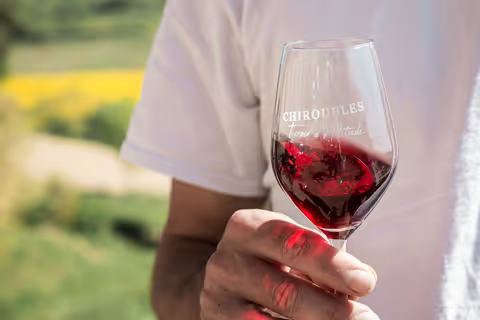
Among the 2023 cuvées tasted, the four chiroubles reveal a remarkable aromatic quality and freshness that sets them apart from the rest of the small 320-hectare appellation. Add to this a Rose de Gamay rosé, sober and crisp in the Beaujolais Villages appellation, and Java, an almost metallic, brut natural sparkling wine. These crus speak volumes about the potential of this pilot estate, at the forefront of a practice that should win over many winegrowers in the years to come.

- Where to find us Château de Javernand, 421 impasse de Javernand, 69115 Chiroubles
- Tel. 09 63 29 82 13
- www.javernand.com